
My Spouse Is Stuck in Their Home Country and Cannot Get a Visa: Wha…
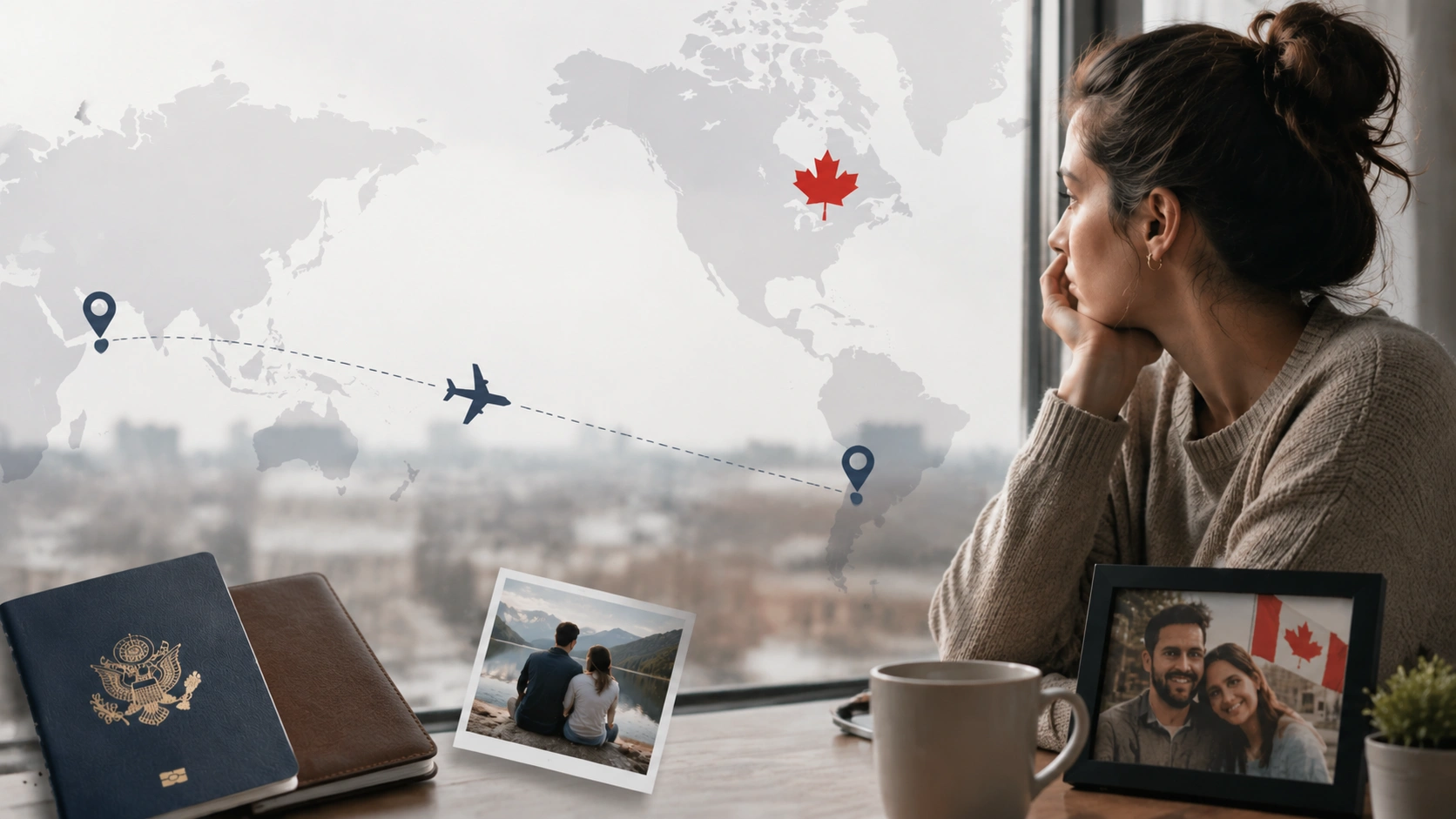
You filed the sponsorship application. While you wait, you have tried to get your spouse a visitor visa so they can be with you. It has been refused. Then refused again. Your spouse is in a country they cannot leave easily, and you are in Canada watching the months go by. You are wondering whether there is anything at all you can do to change this situation.
The frustration you are feeling is legitimate. The situation is genuinely hard. And there are options, though none of them are simple.
Wondering if your situation qualifies?
Why Is This Happening?
A sponsored person who cannot obtain a Canadian visitor visa while a spousal sponsorship is pending is typically facing one or more of these structural challenges:
- Their country of citizenship has a high Canadian visitor visa refusal rate, and the structural refusal patterns make individual applications difficult to approve regardless of personal circumstances
- Their personal travel history is thin, which makes it harder for an officer to assess that they will comply with immigration conditions and return home
- The pending sponsorship application itself creates a dual intent challenge, where the officer cannot be satisfied that the visit intention is genuinely temporary
- Home country ties are insufficient to overcome the officer’s concern about return
None of these are character findings. They are not a verdict on the relationship or on your spouse’s trustworthiness. They are the outputs of an immigration assessment system applied to a specific situation. Understanding them as such is the starting point for figuring out what can be done.
Option 1: A Stronger, More Targeted Visitor Visa Application
If previous visitor visa applications were poorly prepared, or if the circumstances that led to earlier refusals can be addressed, reapplying with a significantly stronger application is a realistic option.
A stronger application should:
- Directly address the specific concerns raised in prior refusals, using GCMS notes to understand exactly what the officer noted
- Provide more compelling evidence of home country ties, employment, family obligations, financial accounts, property, anything that demonstrates a concrete reason to return
- Include a specific, detailed itinerary for the proposed visit including prepaid accommodation and return travel
- Include a letter from the sponsor in Canada explaining the visit plan and confirming the temporary nature of the stay
- Directly acknowledge the pending sponsorship and explain how the temporary visit fits within that longer-term process
Need a personalized review of your file?
Option 2: A Temporary Resident Permit
A Temporary Resident Permit is a discretionary document that allows a person who would not otherwise qualify for temporary entry to enter Canada for a specific, justified purpose. A TRP does not confer permanent residence and is not a substitute for the sponsorship process. But it can allow a separated couple to be together in Canada for a defined period when a visitor visa has repeatedly failed.
To support a TRP application in this situation, the key argument is hardship. A couple who has been separated for an extended period, who is in a genuine committed relationship supported by a pending sponsorship application, and whose separation is causing documented hardship, has a basis for a TRP application that a routine visitor visa application does not.
TRP applications can be submitted through a Canadian visa office abroad, through a port of entry, or in some cases online. Processing times vary by location and circumstance. A TRP is not guaranteed, and the officer’s discretion is real. But for couples in extended, documented separations due to repeated visa refusals, it is a tool worth exploring professionally.
Option 3: Meeting in a Third Country
If Canada remains inaccessible through a visitor visa and a TRP is not immediately available, meeting in a third country where both partners can obtain entry is an option that many separated couples use.
Your spouse may hold a valid visa for another country, such as the United States, the United Kingdom, the Schengen area, or others, that allows them to travel even if they cannot enter Canada. You as the Canadian can travel to meet them. Flights, accommodation, and travel together in a third country generate relationship evidence while providing time together.
Third-country meetings serve both an emotional and an immigration purpose. The documentation generated, photographs, boarding passes, hotel records, and travel records together, is relevant relationship evidence for the sponsorship application.
Have questions about your specific case?
Option 4: Humanitarian and Compassionate Considerations
In situations of genuine extreme hardship, a Humanitarian and Compassionate application, sometimes called an H and C, provides a pathway for a person outside Canada to apply for permanent residence from within Canada on the basis of the hardship that would result from not doing so.
An H and C application for a sponsored person is separate from and parallel to the sponsorship application. It is assessed based on the totality of the circumstances, including the best interests of any children involved, the degree of establishment in Canada, and the hardship of the situation.
H and C applications are discretionary and are not a guaranteed outcome. They are also not a quick process. But for couples facing years of separation due to systemic visa barriers, they represent a legitimate pathway that should be explored with professional guidance.
Option 5: Safety-Based Pathways
If your spouse is stuck in their home country because of genuine safety concerns, such as a risk of persecution, violence, or serious human rights violations, pathways that address those safety concerns directly may be available. A refugee claim, if applicable, or a referral through UNHCR for resettlement are separate from the spousal sponsorship process but may apply to specific situations.
These pathways are highly fact-specific and require professional guidance. They are not appropriate or available in most spousal sponsorship situations, but for couples where the barrier to travel is connected to safety, they are worth understanding.
About the Author
Anuj Sengar (AJ) is the Founder and Licensed RCIC (R515178) at Can X Global Solutions. Licensed by the College of Immigration and Citizenship Consultants since February 2016, he has served 10,000+ clients from 30+ countries. CAPIC R2117054. Completed Generative AI for Business at University of Toronto Rotman, 2025.
FAQ
The sponsorship has been approved but my spouse still cannot enter Canada. What do we do?
A sponsorship approval that results in a Confirmation of Permanent Residence requires the sponsored person to physically land in Canada to activate their permanent residence. If travel barriers prevent them from doing so within the validity period of the COPR, contact IRCC immediately to explain the circumstances and request an extension of the COPR validity. IRCC has discretion to extend validity periods in documented exceptional circumstances. Acting before the document expires is essential.
What if there is no Canadian visa office in my spouse’s country?
If there is no Canadian visa office that serves your spouse’s country directly, IRCC designates alternative processing arrangements for applicants from those countries. Applications may be directed to a visa office in a neighbouring country or processed through a centralised processing hub. IRCC’s website lists the designated office for each country. In practice, the absence of a local office means longer travel to attend appointments or biometrics collection, and potentially longer processing times, but it does not prevent processing.
My spouse has been stuck for over two years. Does that length of separation help our case for a TRP or H and C?
Yes. The duration of separation is a relevant factor in both a TRP and an H and C assessment. A couple that has been separated for two or more years due to documented visa barriers, during which the sponsorship application has been pending or approved, presents a more compelling hardship case than one in a shorter separation. Document the separation thoroughly: the timeline, the visa refusal history, the attempts made to facilitate visits, the financial and personal cost of the separation, and any impact on children or other family members. This documentation is the foundation of a hardship argument.
When your spouse cannot get a visa and the standard process is not working, the path forward requires professional strategy, not more of the same. Can X Global has been navigating exactly these situations for families since 2016. Book a assessment to understand every option available to you.
Need help preparing your application correctly?
Related Articles
- Can my spouse visit Canada during processing?
- My spouse’s visitor visa was refused during sponsorship
- After a refusal: what are our options?
Top Stories
Inland vs Outland Spousal Sponsorship Canada 2026: Which Stream Is Right for You?
Family Sponsorship
Spousal Open Work Permit Canada 2026: How to Work While Your PR Is Processing
Family Sponsorship
Who Can Sponsor a Spouse to Canada in 2026: Full Eligibility Guide
Family Sponsorship
Spousal Sponsorship Canada Documents Checklist 2026
Family Sponsorship
Get Expert Immigration Advice
10+ years helping clients achieve Canadian permanent residency.
Book a Consultation
[astra_custom_layout id=5690]
Get a Consultation
Most Read

Inland vs Outland Spousal Sponsorship Canada 2026: Which Stream Is Right for You?

Spousal Open Work Permit Canada 2026: How to Work While Your PR Is Processing

Who Can Sponsor a Spouse to Canada in 2026: Full Eligibility Guide

Spousal Sponsorship Canada Documents Checklist 2026