





Prove Genuine Relationship Spousal Sponsorship Canada 2026

Every year, applications for spousal sponsorship Canada are refused not because the relationship was fake, but because the documentation did not make it convincingly real on paper. IRCC officers review thousands of applications. They cannot attend your wedding, meet your families, or observe how you interact. They read documents. They look for patterns. They ask one question in many different ways: does this evidence tell a clear, consistent, believable story of two people building a life together?
If your application answers that question compellingly across all categories of evidence, you get approved. If it does not, you get a refusal. This guide explains exactly what IRCC looks for in 2026, how the assessment works legally, and how to build a file that passes the test.
Wondering if your situation qualifies?
Book a ConsultationThe Legal Framework: Section 4 of IRPR
The legal basis for refusing a spousal sponsorship on relationship grounds is Section 4(1) of the Immigration and Refugee Protection Regulations (IRPR). An officer can refuse an application if either of two conditions is met: the relationship is not genuine, or the relationship was entered into primarily for the purpose of acquiring immigration status. The key word is or. An officer only needs to find one of these conditions satisfied. You must prove both that the relationship is genuine and that immigration was not the primary motivation.
This matters in practice because it means that even a genuinely loving relationship can be refused if the timing or circumstances suggest that immigration was the dominant driver. A couple who met two weeks before an immigration deadline, married quickly, and then submitted a spousal sponsorship with minimal evidence of shared life must address both the genuineness of their current relationship and the motivation behind the timing. The past matters. The evidence must cover both.
The Four Pillars of Relationship Evidence
IRCC officers assess relationship evidence across four distinct categories. Experienced practitioners refer to these as the four evidence pillars. A strong application provides compelling evidence across all four. A thin application that covers only one or two pillars, regardless of how much paper is in that category, leaves the officer with an incomplete picture.
Pillar 1: Documentary Evidence
Documentary evidence establishes the formal, institutional recognition of the relationship. It answers the question: what official records show that you are in this relationship?
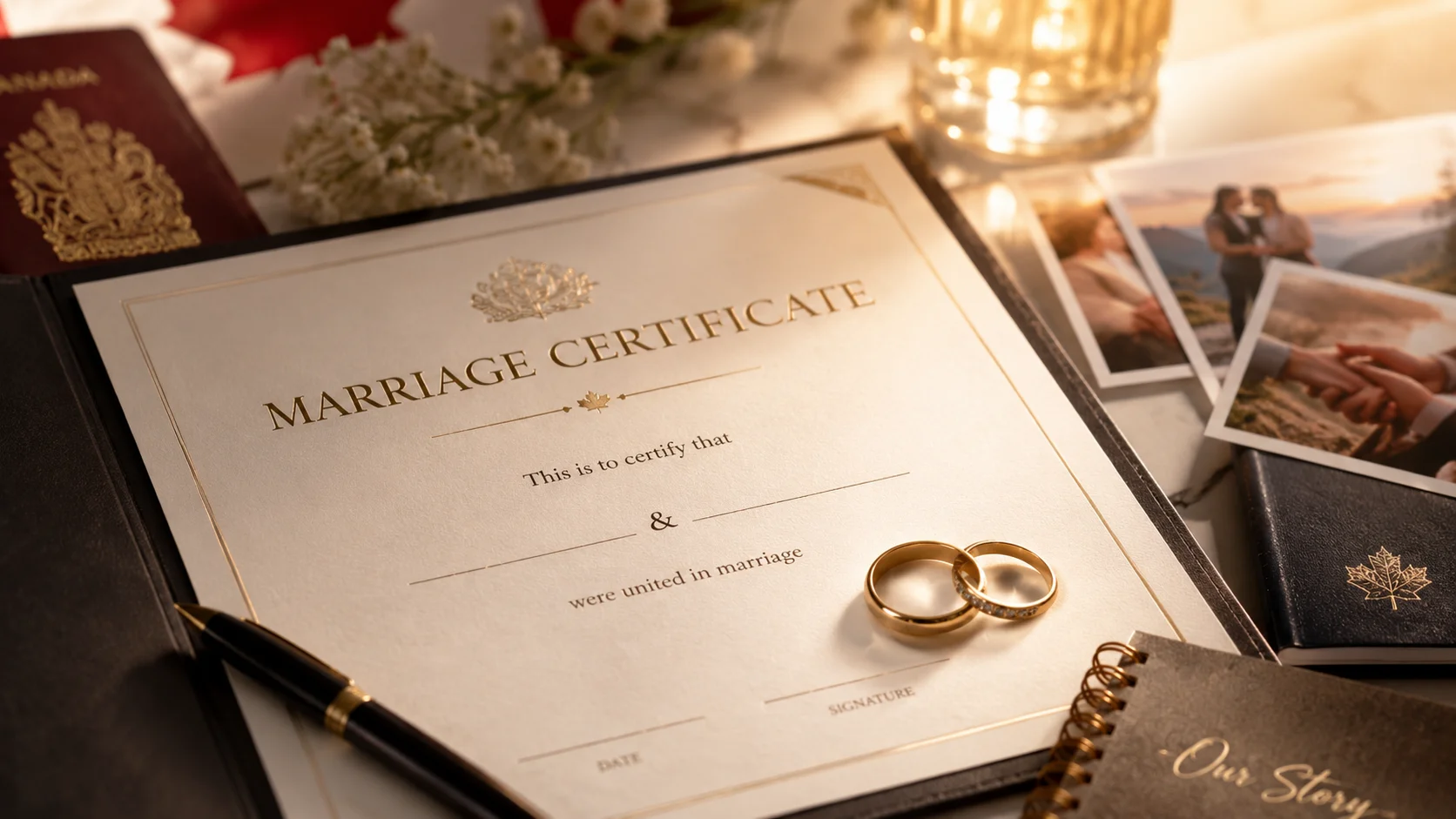
For married couples, the primary documentary evidence is the marriage certificate and proof of its legal registration with the relevant government authority. For common-law partners, it is documentation of shared residence covering the required 12-month cohabitation period.
Secondary documentary evidence for both categories includes: joint lease agreements or mortgage documents, utility bills in both names at the same address, joint bank accounts or credit card statements, insurance policies naming the partner, employment benefits listing the partner as a spouse or dependent, and government documents such as tax returns showing the relationship is recognized.
Documentary evidence is the easiest category for officers to verify because it comes from third parties. A joint lease signed by both parties and a landlord is harder to fabricate than a photograph. Weight documentary evidence heavily.
Pillar 2: Financial Evidence
Financial evidence demonstrates economic interdependence. It answers the question: do these two people financially support each other the way a genuine couple does?
Strong financial evidence includes records of money transfers between partners across the relationship timeline, joint savings or investment accounts, shared credit facilities, documented contributions to shared household expenses, and evidence that one partner was named as a beneficiary on the other’s insurance or retirement accounts.
Financial evidence is particularly important for long-distance relationships where cohabitation evidence may be limited. A couple who has been sending each other money consistently for three years is demonstrating a committed partnership through their financial behaviour, regardless of whether they have lived together.
Pillar 3: Communication Evidence
Communication evidence shows the frequency, consistency, and depth of contact between the partners over time. It answers the question: do these two people communicate the way a genuine couple does?
IRCC’s official checklist asks for proof of contact, including printed messages, emails, call logs, or social media conversations. The maximum specified is 10 pages. What matters is not volume but representative consistency. A selection of messages across the timeline of the relationship, showing regular and substantive contact in multiple formats, is more useful than 10 pages of messages from the week before submission.
Include call logs showing the frequency of voice or video calls. Include screenshots of video calls when available. Include messages that reference specific shared events, plans, and experiences. Avoid submitting messages that are purely transactional or that say nothing about the relationship itself.
Pillar 4: Social and Family Evidence
Social evidence demonstrates that the relationship is recognized by people who know the couple in real life. It answers the question: do the people in this couple’s lives know and acknowledge this relationship?
The most useful social evidence is photographs spanning the full history of the relationship, taken in different locations and contexts, accompanied by written descriptions explaining who is in each photo and what the occasion was. Include photos from ordinary daily life, not only from formal events. An officer looking at 20 professional wedding portraits and nothing else sees a wedding, not a life together.
Support letters from family members and friends who know the couple personally carry significant weight when they are specific. A letter that says the writer has known the couple since they met in 2021, attended their wedding, visited them at their shared home, and can describe specific observations about how the couple interacts is valuable. A letter that says the couple appears happy and the writer wishes them well is not.
Social media presence, where both partners publicly acknowledge the relationship, can also be submitted as supplementary evidence. Private profiles or the absence of any public acknowledgment of the relationship in the context of a claimed long-term partnership can raise questions.
Need a personalized review of your file?
Get a Case ReviewIMM 5532: The Most Important Document in Your Application
The Relationship Information and Sponsorship Evaluation form (IMM 5532) is the primary framework IRCC officers use to assess your relationship. It is not a formality. Officers read it closely and cross-reference every answer against your evidence package.
The form asks both the sponsor and the sponsored person detailed questions about how you met, how the relationship developed over time, when you became a couple, when you became engaged or decided to marry, what you know about each other’s daily lives, families, habits, and future plans, and what you plan to do together in Canada.
The critical IMM 5532 rule
Every answer in IMM 5532 must be consistent with your evidence. If you write that 50 people attended your wedding, you should have photographs showing a large gathering. If you describe weekly video calls for the past three years, your communication records should reflect that. If you state your partner’s daily routine, it should be consistent with what your partner would independently say about their own routine. Inconsistencies between the form and the evidence are the most common trigger for Procedural Fairness Letters and interviews.
Have questions about your specific case?
Talk to an AdvisorThe sponsor signs Part A, Question 9 and Part C, Question 12. The sponsored person signs Part B, Question 5 and Part C, Question 13. Both parties must complete the form together, though they fill out their respective sections. A form submitted with the wrong sections signed, or sections left unsigned, triggers a return.
Write with specific, concrete details. Describe particular memories, specific shared experiences, and genuine knowledge of each other’s lives. The difference between a convincing IMM 5532 narrative and a weak one is specificity. Generic statements about enjoying time together do not help. Specific, idiosyncratic details that only a genuine couple would know do.
Red Flags and How to Address Them
Certain circumstances in a spousal sponsorship application shift the burden of proof onto the applicants to provide stronger evidence. Having a red flag does not mean automatic refusal. It means the evidence package must work harder to compensate. Understanding which circumstances raise scrutiny, and how to address each one, is part of building a strategic application.
Short courtship or quick marriage. Officers note applications where the couple met and married within a short window, particularly if that window coincides with an immigration event. Address this with a detailed IMM 5532 narrative explaining the timeline, supported by communication records and other evidence demonstrating the depth of the relationship despite its brevity.
Large age gap. A significant age difference is not automatically disqualifying, but it raises a question that the application should proactively answer. Explain the relationship’s history, how the couple met, and what drew them together. Evidence of shared values, interests, and life plans helps contextualize the age difference.
Arranged marriage. IRCC does not refuse arranged marriages. Officers assess whether the relationship is genuine as it stands now, regardless of how it began. For arranged marriage applications, focus on the period after the arrangement: communication history, visits, family involvement from both sides, and the genuine development of the relationship after introduction. A letter of explanation providing cultural context for how the arrangement works in your community is also helpful.
Online relationship with few or no in-person meetings. If in-person meetings were limited due to visa restrictions or other barriers, explain this in IMM 5532 Part C, Question 4. Compensate with volume and depth of communication evidence: call logs, video call screenshots, message history across years. If any in-person visits occurred, document them thoroughly with travel evidence.
Sponsored person was listed as non-accompanying on a prior immigration application. This pattern has received heightened IRCC scrutiny in 2025 and 2026. If a person obtained PR through Express Entry or another stream, listed their spouse as non-accompanying to simplify the application, and is now sponsoring that spouse, officers examine the application for signs that the marriage was motivated by immigration strategy. A detailed IMM 5532 narrative, extensive communication history predating the prior PR application, and evidence that the relationship was active and genuine throughout the prior immigration process are essential.
Previous immigration refusals for the sponsored person. Prior refusals are visible in IRCC’s system and may prompt additional scrutiny. They do not bar sponsorship but should be addressed honestly in the application with a brief explanation.
Organizing Your Evidence Package
How you present evidence matters almost as much as what you submit. A well-organized evidence package with a clear cover letter explaining each category of evidence makes the officer’s assessment easier and reduces the chance of an important document being missed.
Create a simple evidence index at the front of your relationship evidence section listing each category and the documents you have included. Organize documents chronologically within each category where possible. Use section labels or tabs to separate communication evidence, financial evidence, photographs, and support letters.
Do not submit everything you have. Submit the best evidence from each category, organized clearly. A 400-page evidence package with no structure is harder to assess than an 80-page package that tells the story directly.
At Can X Global Solutions, reviewing relationship evidence packages before submission is one of the most common requests from clients who have done their own research but want a professional assessment before filing. The pattern we see most consistently is strong evidence in one category and almost nothing in the others. A couple with extensive communication records but no financial interdependence evidence and generic photographs leaves an officer with a partially told story. The four-pillar framework works because each pillar addresses a different dimension of a genuine relationship. A full picture requires all four.
Need help preparing your application correctly?
Book a ConsultationFrequently Asked Questions
How many photographs should I include?
IRCC’s checklist specifies up to 20 photographs with descriptions. For married couples who answer yes to all four qualifying questions (currently living together, children together, first marriage for both, married two or more years), photographs may not be required. For all other applicants, provide up to 20 photographs taken at different times and in different places, each with a brief description of the date, location, and people shown. Include ordinary life photographs alongside formal occasion photographs.
Our relationship is long-distance. We do not have joint financial records. What should we submit?
For long-distance relationships, prioritize communication evidence covering the full timeline of the relationship, money transfer records showing financial support between partners, travel evidence showing in-person visits, and support letters from people who know both partners and can speak to the relationship. If no visits took place due to visa barriers or other exceptional circumstances, explain this explicitly in IMM 5532 Part C, Question 4.
What makes a support letter from a family member or friend useful to IRCC?
A useful support letter names the writer, explains how long they have known the couple, describes specific events they personally witnessed such as a wedding, a visit to the shared home, or family gatherings, and makes a clear statement about why they believe the relationship is genuine based on their own observations. Generic letters stating that the couple is happy together carry almost no weight. Specific, personal, dated, and verifiable details carry significant weight.
We married quickly. Will IRCC refuse our application?
A short courtship and quick marriage is a factor officers note, but it is not an automatic refusal. It shifts the burden to you to provide stronger evidence across all four pillars demonstrating that the relationship is genuine as it now stands. A detailed IMM 5532 narrative explaining the timeline and what drew you together, combined with comprehensive communication, financial, and social evidence covering the full period of the relationship, addresses this concern directly.
Does our social media need to be public for IRCC to accept it as evidence?
Social media can be submitted as supplementary evidence regardless of whether profiles are public. Screenshots of posts, messages, tagged photographs, and shared content can all be included. If both partners have active social media and the relationship is not publicly visible at all despite being claimed to have lasted years, that absence can itself raise questions. An officer does not require public profiles but may note a conspicuous lack of any social acknowledgment of a long-claimed relationship.
Get Expert Immigration Advice
10+ years helping clients achieve Canadian permanent residency.
Book a ConsultationTrusted by Clients from 30+ Countries
We provide trusted and effective Immigration solutions, assisting clients from around the world in successfully starting their new life in Canada.
Most Read
View all →
Inland vs Outland Spousal Sponsorship Canada 2026: Which Stream Is Right for You?

Spousal Open Work Permit Canada 2026: How to Work While Your PR Is Processing

Who Can Sponsor a Spouse to Canada in 2026: Full Eligibility Guide
Spousal Sponsorship Canada Documents Checklist 2026