




Spousal Open Work Permit Canada 2026 Policy Changes Explained
Published by: Can X Global Solutions Inc.
Effective: Jan 21 2025 / Mar 4 2026 / Dec 31 2026 extension
Source: IRCC Program Delivery Instructions & Public Policy
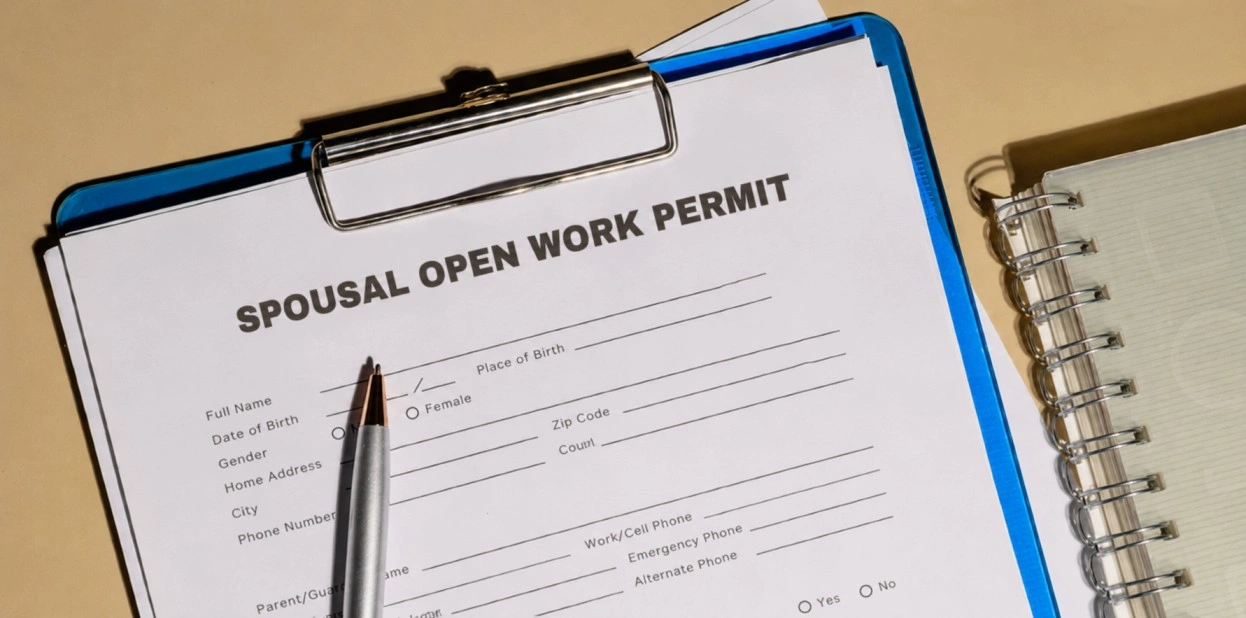
The Spousal Open Work Permit (SOWP) landscape shifted three times between January 2025 and March 2026. Two of those changes restricted eligibility. One extended a critical public policy that benefits sponsored spouses in Canada. If your file involves any form of spousal work permit during the sponsorship process, understanding which rules apply to which application code is essential.
The most important distinction in 2026
There are four different open work permit codes used by spouses and partners in Canada. The changes introduced in January 2025 and March 2026 affected two of them — C41 and C42 — and do not affect the Family Class sponsorship code A74, which is the code relevant to most sponsored spouses applying while their PR application is in process.
Wondering if your situation qualifies?
Book a ConsultationThe Four Open Work Permit Codes at a Glance
| Code | Who It Applies To | Key 2026 Rule | Status |
|---|---|---|---|
| A74 | Sponsored spouses or partners in Canada — Family Class (inland or outland applying in Canada) | Apply after AOR. Extended through December 31, 2026 under public policy. Outland applicants in Canada use this code. | Active — extended |
| A75 | Economic class principal applicants (Express Entry, PNP) and their spouses — Bridging Open Work Permit | Requires active PR application past completeness check. Unaffected by January 2025 or March 2026 changes. | Active — no changes |
| C41 | Spouses and common-law partners of foreign workers | Principal worker must hold TEER 0, 1, or eligible TEER 2 or 3 position. Stricter rules since January 21, 2025. | Active — eligibility tightened Jan 2025 |
| C42 | Spouses and common-law partners of international students | Effective March 4, 2026: refused if principal student is in their final academic term at time of application. Does not affect A74 or A75. | Modified — March 4, 2026 |
Change 1: January 21, 2025 — Stricter Rules for Spouses of Foreign Workers
Effective January 21, 2025, IRCC tightened eligibility for C41 open work permits — those issued to spouses or common-law partners of foreign workers holding LMIA-based work permits. Under the new rules, the principal foreign worker must hold a position classified under TEER category 0 or 1, or hold an eligible TEER 2 or 3 occupation on IRCC’s published list. Most TEER 4 and TEER 5 workers no longer qualify. The principal worker must also have at least 16 months of valid work authorization remaining.
This change does not affect Family Class A74 applications. Sponsored spouses and partners who have submitted their PR application and are applying for an SOWP while that PR processes are unaffected by the C41 changes.
Need a personalized review of your file?
Get a Case ReviewChange 2: March 4, 2026 — Final-Term Restriction for Student Spouses
Effective March 4, 2026, IRCC updated its program delivery instructions for C42 open work permits — those issued to spouses or common-law partners of international students. Under the new rule, a C42 application is refused if the principal international student is in their final academic term at the time the work permit application is received by IRCC.
Applications submitted before March 4, 2026 are grandfathered and processed under the old rules. Renewals are subject to the new restriction. This change does not affect A74 or A75 applications.
Change 3: The Public Policy Extension — A74 Through December 31, 2026
The most significant news for sponsored spouses in 2026 is what did not change, and what was extended. IRCC’s public policy that allows outland-sponsored spouses physically present in Canada to apply for an open work permit using the A74 exemption code — rather than having to choose between the open work permit and outland stream — has been extended through December 31, 2026.
Before this public policy was introduced in 2023, couples faced a forced choice: apply inland and access an open work permit but face longer processing times and no appeal rights, or apply outland and accept that the sponsored person could not work in Canada during the 15-month processing period. The public policy eliminated this trade-off by allowing outland applicants in Canada to apply for the SOWP using A74 while the outland PR file processes.
The December 31, 2026 extension confirms that this option remains available throughout 2026 for eligible applicants. After AOR is received — typically four to eight weeks after submission — the sponsored person can apply for the A74 open work permit. Processing time for the work permit itself is currently approximately 259 days (about 8.5 months). The sponsored person can begin working as soon as the work permit is issued.
Have questions about your specific case?
Talk to an AdvisorApplying for the A74 SOWP: What You Need to Know
- Apply after receiving AOR — the work permit application requires the AOR as a supporting document.
- Apply online using the correct exemption code: A74 for Family Class sponsored spouses, not A75 (which is the Bridging Open Work Permit code for economic class applicants).
- The sponsored person must be physically in Canada with valid temporary status when applying. Visitors, students, and work permit holders who are inside Canada with a valid status all qualify.
- The two-week emergency exception applies if the sponsored person’s temporary status expires within 14 days of the sponsorship submission and the AOR has not yet arrived — apply for the SOWP without the AOR in that narrow window.
- Government fees: $255 CAD ($155 processing + $100 open work permit holder fee), plus $85 for biometrics if not already on file.
At Can X Global Solutions, the A74 open work permit extension through December 2026 is among the most practically valuable policy continuations for clients managing separation and work authorization during the sponsorship wait. The distinction between A74, A75, C41, and C42 causes significant confusion in applications — using the wrong code results in delays or refusals that could have been avoided. Our team confirms the correct code for every client’s specific situation before any work permit application is submitted, as a matter of standard practice.
Need help preparing your application correctly?
Book a ConsultationFrequently Asked Questions
I applied outland but my spouse is in Canada. Which SOWP code do they use?
A74. The Family Class exemption code applies to sponsored spouses who are in Canada and have received an AOR for a spousal sponsorship PR application, regardless of whether the underlying sponsorship is inland or outland. The A74 code is for family class applicants. A75 is the Bridging Open Work Permit for economic class applicants and is a different program with different eligibility requirements.
Does the December 31, 2026 extension mean the A74 public policy will end at the end of this year?
The extension confirms the public policy is active through December 31, 2026. Whether it will be extended beyond that date has not been announced as of April 2026. IRCC typically announces policy extensions or changes before expiry. Monitor canada.ca and IRCC’s public policy announcements for updates as that date approaches.
My spouse is a student’s spouse on a C42 permit. How does the March 2026 change affect their renewal?
If the principal international student is in their final academic term at the time the renewal application is received by IRCC, the renewal will be refused under the new March 4, 2026 instruction. Applications submitted before March 4, 2026 are grandfathered. If you are approaching renewal and the student is in their final term, review the current IRCC instructions carefully and consider whether any alternative work authorization pathways apply.
Get Expert Immigration Advice
10+ years helping clients achieve Canadian permanent residency.
Book a ConsultationTrusted by Clients from 30+ Countries
We provide trusted and effective Immigration solutions, assisting clients from around the world in successfully starting their new life in Canada.
Most Read
View all →
Inland vs Outland Spousal Sponsorship Canada 2026: Which Stream Is Right for You?

Spousal Open Work Permit Canada 2026: How to Work While Your PR Is Processing

Who Can Sponsor a Spouse to Canada in 2026: Full Eligibility Guide

Spousal Sponsorship Canada Documents Checklist 2026