






Spousal Sponsorship Refused in Canada? Your Options: IAD Appeal, Reapplication and Judicial Review

A spousal sponsorship refusal is not necessarily the end. It is, however, the beginning of a time-sensitive period where the decisions you make in the next few days can either preserve meaningful options or close them permanently. The 30-day appeal deadline is real, strictly enforced, and not extended on the basis of emotional distress or not knowing it existed.
Your Options: IAD Appeal, Reapplication and Judicial Review A spousal sponsorship refusal is not necessarily the end.
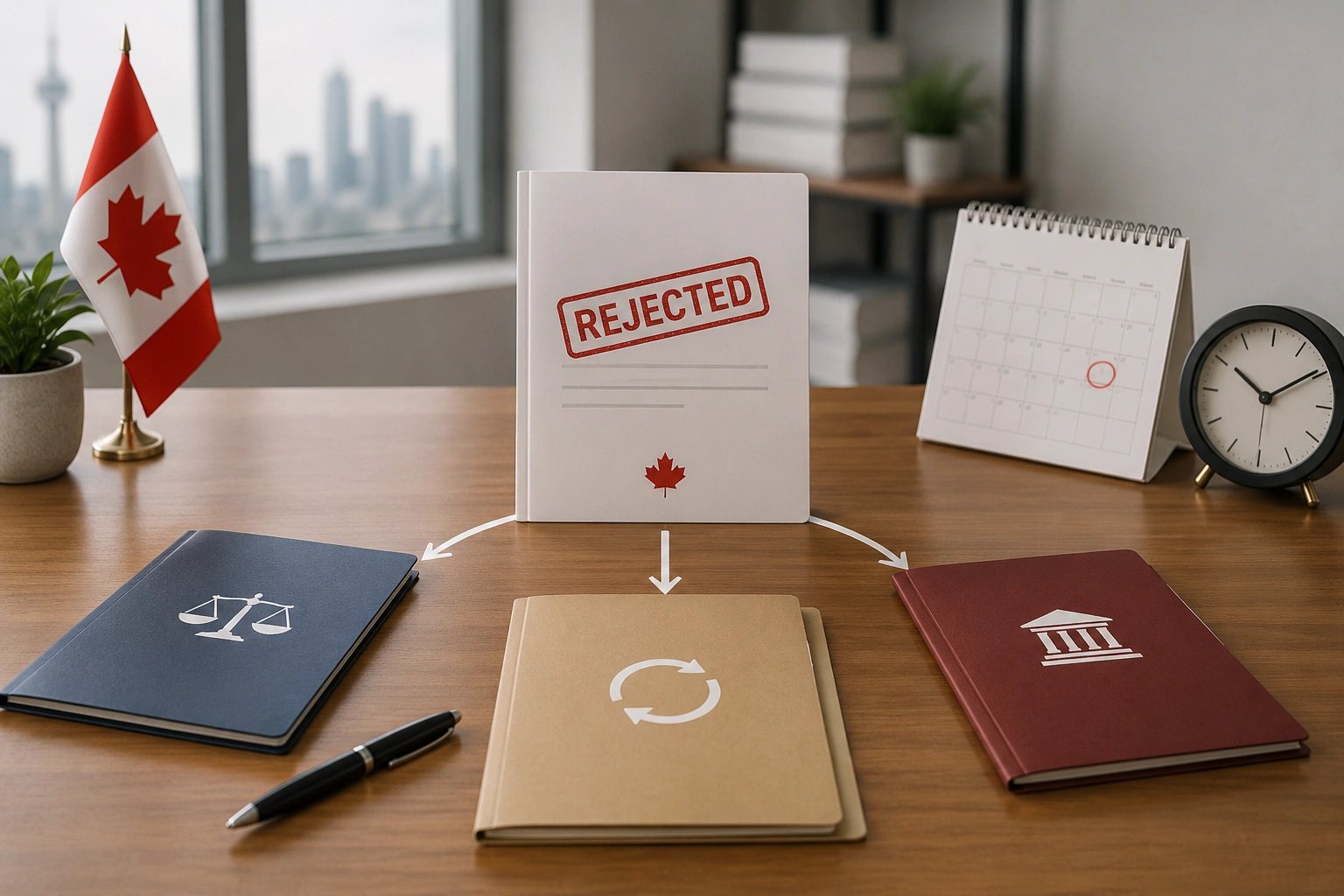
This guide explains all three options available after a spousal sponsorship refusal in 2026: an IAD appeal, a reapplication, and Federal Court judicial review. Each option is appropriate for different situations. Understanding which one fits your circumstances — and acting within the relevant deadlines — is the most important thing you can do in the days following a refusal.
Do this first, before anything else:
Order GCMS notes through an ATIP request immediately after receiving a refusal. The refusal letter often does not contain the officer’s full reasoning. The GCMS notes do. Understanding exactly why you were refused is the starting point for every response strategy.
Just received a refusal? Speak with our team before the 30-day clock runs out.
Book a ConsultationOption 1: IAD Appeal — For Outland Refusals Only
The Immigration Appeal Division (IAD) is a tribunal within the Immigration and Refugee Board of Canada that hears appeals of family class sponsorship refusals. It is the most powerful option available after an outland (Family Class) refusal because it provides a de novo hearing — a completely fresh review of the evidence — and allows both partners to testify in person (or by videoconference), new evidence to be introduced, and humanitarian and compassionate arguments to be made.
Who Can Appeal and Who Cannot
Only the sponsor can file the appeal. The sponsored person is a party but cannot initiate the appeal. The sponsor must be a Canadian citizen or permanent resident.
IAD appeal rights are not available in every refusal situation. You cannot appeal to the IAD when:
You cannot appeal to the IAD when: The refusal is an inland (Spouse or Common-Law Partner in Canada Class) refusal.
- The refusal is an inland (Spouse or Common-Law Partner in Canada Class) refusal. Inland refusals carry no IAD appeal right. Federal Court judicial review is the only recourse.
- The sponsored person has been found inadmissible on grounds of serious criminality (a conviction with a sentence of two years or more).
- The sponsored person has been found inadmissible on security grounds, human rights violations, or organized criminality.
- The refusal is based on Regulation 117(9)(d) — an excluded family member who was not declared in a prior PR application. This creates a permanent bar with no IAD appeal rights whatsoever.
The Three Grounds for Allowing an IAD Appeal
Under Section 67(1) of IRPA, the IAD can allow a sponsorship appeal on three grounds. Your appeal strategy should identify which ground or combination of grounds applies to your case.
Ground 1: Wrong in law, fact, or mixed law and fact. The officer made a legal or factual error in the refusal decision. This includes unreasonable findings of credibility, selective reading of evidence, misinterpretation of the relationship test, or failure to consider material evidence that was before the officer.
Ground 2: Natural justice was not observed. The officer breached the duty of procedural fairness — for example, by refusing on a concern not raised in the Procedural Fairness Letter, or by providing a PFL deadline and then refusing before the deadline expired. A 2026 Federal Court decision (Sandhu v. Canada, 2026 FC 212) confirmed that refusing before a PFL deadline passes is a breach of procedural fairness.
Ground 3: Humanitarian and compassionate relief. Even where the refusal was technically correct, the IAD can grant relief if the best interests of a child directly affected are engaged, or if sufficient humanitarian and compassionate factors justify allowing the appeal despite the refusal grounds. Long separation, established family ties in Canada, and country conditions in the sponsored person’s home country are all relevant H&C factors.
Need a strategic review of your IAD appeal grounds?
Get a Case ReviewThe IAD Appeal Process: Stage by Stage
| # | Stage | What Happens | Deadline |
|---|---|---|---|
| 1 | File Notice of Appeal | Sponsor files Notice of Appeal and copy of refusal letter with the IAD. Only the sponsor can file — not the sponsored person. Both the Notice and refusal letter must be received by the IAD. | 30 days from refusal letter |
| 2 | Minister provides Appeal Record | The Canada Border Services Agency (CBSA), acting for the Minister, provides the full appeal record containing the original application materials and IRCC’s reasons for refusal. | 60 days after IAD receives notice |
| 3 | Sponsor discloses evidence | Sponsor discloses all documents they plan to introduce at the hearing, including new relationship evidence, updated financial records, and any materials not in the original file. Documents must be served on the Minister’s counsel and filed with the IAD. | Typically 30 days before hearing |
| 4 | ADR (Alternative Dispute Resolution) | An informal process where the sponsor has the opportunity to meet with a CBSA representative and attempt to resolve the appeal without a full hearing. If CBSA consents to allow the appeal, it is allowed without a hearing. If not, the matter proceeds. | Scheduled before hearing date |
| 5 | Full IAD Hearing | A formal hearing before an IAD Member. The sponsor, sponsored person (often by videoconference), and any witnesses testify. Minister’s counsel cross-examines. The sponsor’s representative makes legal submissions. New evidence is introduced. | Scheduled 12–18 months from filing |
| 6 | Decision | The IAD Member issues a written decision allowing or dismissing the appeal. If allowed, IRCC resumes processing. If dismissed, Federal Court judicial review is possible within 15 days. | 1–3 months after hearing |
What Happens If the Appeal Succeeds
If the IAD allows the appeal, IRCC resumes processing the permanent residence application. Updated medical examinations and police certificates are typically required, as they will have expired during the appeal period. A new admissibility assessment is not conducted on the same grounds — the IAD’s decision on the relationship’s genuineness is binding on IRCC. The total timeline from refusal to final PR approval following a successful appeal typically runs two to three years.
Scheduled 12–18 months from filing 6 Decision The IAD Member issues a written decision allowing or dismissing the appeal.
If dismissed, Federal Court judicial review is possible within 15 days. 1–3 months after hearing What Happens If the Appeal Succeeds If the IAD allows the appeal, IRCC resumes processing the permanent residence application.
Scheduled before hearing date 5 Full IAD Hearing A formal hearing before an IAD Member.
Typically 30 days before hearing 4 ADR (Alternative Dispute Resolution) An informal process where the sponsor has the opportunity to meet with a CBSA representative and attempt to resolve the appeal without a full hearing.
What Happens If the Appeal Is Dismissed
If the IAD dismisses the appeal, the only remaining option is an application for leave to seek judicial review in the Federal Court of Canada. This application must be filed within 15 days of receiving the IAD’s written decision. Federal Court judicial review of an IAD decision is more limited than the IAD appeal itself — the Court assesses whether the IAD’s decision was reasonable, not whether it was correct. New evidence cannot be introduced.
Preparing for an IAD hearing? Talk to a representative with appeal experience.
Talk to an AdvisorOption 2: Reapplication
Reapplying after a refusal is available for all refusal grounds except R117(9)(d) excluded family members. A reapplication starts fresh: new forms, new fees, new processing timeline. The prior refusal is visible in IRCC’s system and will be cross-referenced during processing of the new application.
A reapplication only makes sense if the reasons for the original refusal can be meaningfully addressed. If the refusal was based on thin relationship evidence, reapplying with a comprehensive evidence package built across all four pillars — and directly addressing the specific concerns raised in the GCMS notes from the first refusal — is a viable and often successful path. If the refusal was based on a legal bar such as sponsor ineligibility or R117(9)(d) exclusion, reapplying without resolving the underlying issue will produce the same result.
For outland refusals where an IAD appeal is available, the decision between appealing and reapplying is strategic. An IAD appeal preserves the de novo review option and allows new evidence, but takes 12 to 24 months. A reapplication can be submitted immediately but starts the processing clock again at 15 months. Seek professional advice before choosing between these paths.
Trying to choose between appealing and reapplying? Get tailored guidance.
Book a ConsultationOption 3: Federal Court Judicial Review
Federal Court judicial review is the mechanism for challenging IRCC decisions that cannot be appealed to the IAD: inland refusals, IAD decisions that have been dismissed, and inadmissibility findings on serious criminality or security grounds where no IAD appeal is available.
Judicial review is not an appeal. The Federal Court does not make a new decision on the relationship’s genuineness or the sponsor’s eligibility. It assesses whether the IRCC officer’s or IAD Member’s decision was reasonable, whether the legal test was correctly applied, and whether procedural fairness was observed. If the Court finds the decision unreasonable, it sends the matter back to IRCC or the IAD for redetermination by a different officer or member. The Court does not itself approve the application.
An application for leave to seek judicial review of an IRCC decision must be filed within 60 days. An application for leave to review an IAD decision must be filed within 15 days. These deadlines are strict and cannot be extended on the basis of not knowing they exist. The process is legally complex and requires representation by an authorized immigration lawyer or consultant with Federal Court experience.
Considering a Federal Court challenge after an inland refusal?
Get Expert HelpUnderstanding the underlying reasons for your refusal is the starting point. Read our companion guide to the 11 most common spousal sponsorship refusal reasons and the patterns that trigger IRCC scrutiny in 2026. If your refusal followed a Procedural Fairness Letter, also see our breakdown of how to respond to a PFL effectively.
Start with our complete Spousal Sponsorship Canada 2026 guide — every stage, every rule, fully explained.
Read Guide → →See the full eligibility requirements: who can and cannot sponsor a spouse to Canada in 2026.
Read Guide → →A Note From Can X Global Solutions
At Can X Global Solutions, refusal cases require the clearest strategic thinking of any file we work on, because the options are not equal and the deadlines are unforgiving. The 30-day IAD window and the 15-day Federal Court window do not care how devastated a couple is. The first conversation after a refusal should be about which option is available, which is appropriate, and what needs to happen in the next 30 days. Everything else can wait.
Frequently Asked Questions
I received an inland refusal. Can I appeal to the IAD?
No. Inland (Spouse or Common-Law Partner in Canada Class) refusals do not carry IAD appeal rights. Your only legal remedy for an inland refusal is Federal Court judicial review, which must be filed within 60 days. This is one of the most significant reasons why choosing the outland stream is strategically advantageous when both options are available.
Can my spouse testify at the IAD hearing even though they are outside Canada?
Yes. The IAD regularly accepts videoconference testimony from sponsored persons who are outside Canada. Credible, specific testimony from both partners about the history and details of the relationship is often one of the most decisive elements of a successful appeal. Prepare both partners thoroughly before any hearing.
Is it better to appeal or to reapply?
It depends on why you were refused and the strength of new evidence you can provide. An IAD appeal allows new evidence and live testimony, which is powerful for cases where the original refusal was based on insufficient evidence rather than dishonesty. Reapplication starts fresh but takes another 15 months from submission. In some cases, both paths are pursued simultaneously — reapplication while the IAD appeal is pending. Seek professional advice before choosing.
How long does an IAD appeal take?
From filing the Notice of Appeal to a final written decision, the IAD sponsorship appeal process typically takes 12 to 24 months. This includes the 60-day period for the Minister to produce the appeal record, evidence disclosure periods, possible ADR, hearing scheduling, the hearing itself, and the decision. Timelines vary by IAD regional office and case complexity.

Inland vs Outland Spousal Sponsorship Canada 2026: Which Stream Is Right for You?

Spousal Open Work Permit Canada 2026: How to Work While Your PR Is Processing

Who Can Sponsor a Spouse to Canada in 2026: Full Eligibility Guide

Spousal Sponsorship Canada Documents Checklist 2026