





Canada Immigration Levels Plan 2026 Spousal Sponsorship Impact
Published by: Can X Global Solutions Inc.
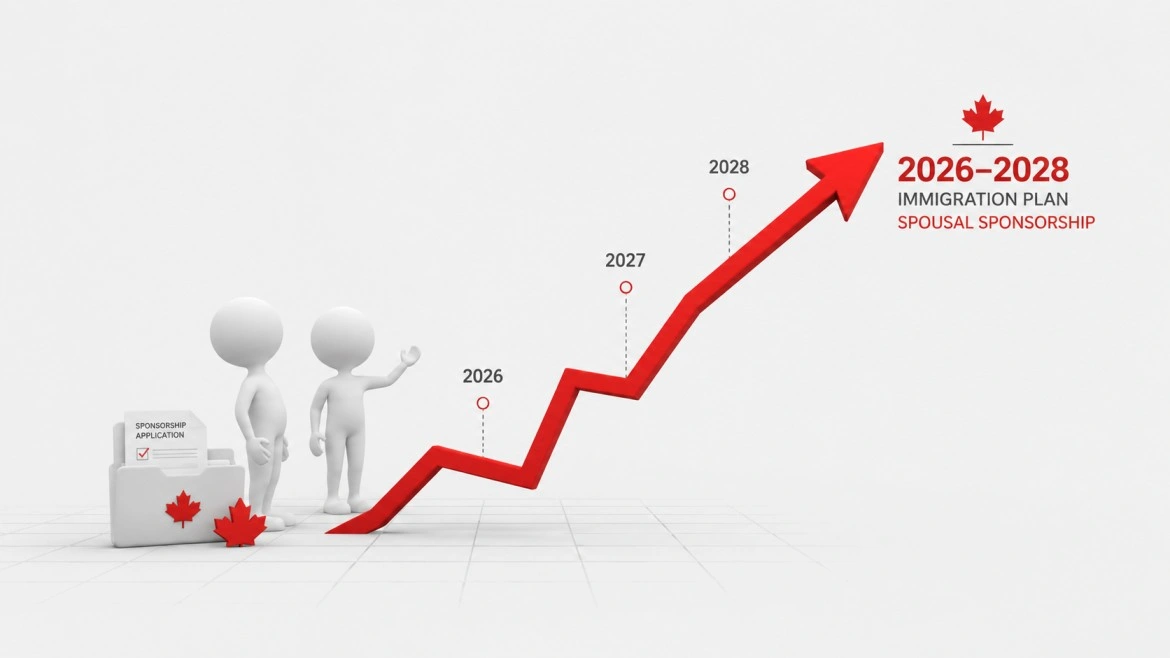
Effective: November 2025 — applies 2026 to 2028
Source: IRCC 2026-2028 Immigration Levels Plan
Canada has announced its immigration targets for 2026 through 2028. For spousal sponsorship applicants, the headline number is a family admission target of 84,000 in 2026, dropping to 81,000 in both 2027 and 2028. Spousal sponsorship remains one of the strongest pathways to Canadian permanent residence — but the numbers behind this plan have real implications for processing timelines and application strategy.
What changed
Canada is reducing its overall immigration intake slightly from previous targets. The Family Class is protected as a share of total admissions but faces a 3,000-spot reduction from 2026 to 2027. Spousal sponsorship itself — unlike the Parents and Grandparents Program — operates without an annual application cap. However, IRCC manages its processing inventory against admission targets, which means the total number of spots available affects how quickly files move through the system.
Wondering if your situation qualifies?
Book a ConsultationThe Numbers at a Glance
| Category | 2026 | 2027 | 2028 |
|---|---|---|---|
| Total PR admissions target | 380,000 | 380,000 | 380,000 |
| Family Class — total | 84,000 | 81,000 | 81,000 |
| Spouses, Partners and Children | 69,000 | 66,000 | 66,000 |
| Parents and Grandparents | 15,000 | 15,000 | 15,000 |
| Family Class as % of total | ~22.1% | ~21.3% | ~21.3% |
What This Means for Spousal Sponsorship Specifically
Unlike the Parents and Grandparents Program, spousal sponsorship does not operate on an annual intake cap or lottery. Canadian citizens and permanent residents can submit a spousal sponsorship application at any time throughout the year, and IRCC accepts those applications continuously. The admission target governs how many applications reach final approval — not who can apply.
The practical implication is timing. With 84,000 family class admission spots available in 2026 and 81,000 in 2027 and 2028, couples who submit applications earlier in 2026 position themselves to be finalized against the larger 2026 pool. Applications submitted late in 2026 may be finalized against the tighter 2027 target. IRCC manages its inventory actively to align with these targets, and year-end dynamics can slow processing as the department approaches its annual cap.
Need a personalized review of your file?
Get a Case ReviewProcessing Times as of April 2026
The current official IRCC processing times as of April 7, 2026 are:
- Outland (Family Class, outside Quebec): 15 months
- Inland (Spouse or Common-Law Partner in Canada Class, outside Quebec): 24 months
- Quebec-destined outland: 35 months
- Quebec-destined inland: 36 months
These figures represent the time to process 80% of completed applications. They are rolling estimates updated monthly. Individual file timelines vary based on visa office, case complexity, and whether additional checks are required.
What Has Not Changed
Canada’s commitment to family reunification through spousal sponsorship is unchanged. The Family Class maintains approximately 22% of Canada’s total PR admissions — the same proportional commitment as in prior years. The genuine relationship test under Section 4(1) of IRPR is unchanged. The eligibility requirements for both sponsor and sponsored person are unchanged. The two-stage processing structure — sponsor eligibility followed by PR assessment — is unchanged.
What has changed is the arithmetic of spots available and the trajectory of that number over the next three years. Couples who are ready to apply should not delay on the expectation that processing will speed up — the 3,000-spot reduction from 2026 to 2027 creates a mild incentive toward earlier submission.
At Can X Global Solutions, immigration levels plan updates are something we monitor closely for clients at every stage of the process. The reduction from 84,000 to 81,000 family admissions is meaningful in context — it affects how IRCC manages its inventory toward year-end — but it does not change the fundamental eligibility or evidence requirements for spousal sponsorship. Our advice remains consistent: submit a complete, well-organized application as early as you are genuinely ready. A complete file on the first submission is still the single most effective thing a couple can do to optimize their processing timeline within this system.
Have questions about your specific case?
Talk to an AdvisorFrequently Asked Questions
Does the admission target cap mean I cannot apply if the number is reached?
No. Spousal sponsorship does not have an intake cap like the Parents and Grandparents Program. There is no application cap and no lottery. The admission target governs final approvals in a given year, not who submits applications. Couples can apply at any time throughout the year.
Will processing times improve in 2026 as a result of the levels plan?
Not automatically. The processing time estimate reflects the current inventory of applications and IRCC’s processing capacity, not the admission target alone. IRCC publishes updated processing times monthly at canada.ca and those figures are the best available estimate of current wait times.
Does Canada still prioritize family reunification in its immigration plan?
Yes. The Family Class is maintained at approximately 22% of total PR admissions across the 2026 to 2028 period, consistent with Canada’s long-standing policy commitment to family reunification. The absolute number of spots drops slightly from 2026 to 2027, but the proportional commitment is unchanged.
Get Expert Immigration Advice
10+ years helping clients achieve Canadian permanent residency.
Book a ConsultationTrusted by Clients from 30+ Countries
We provide trusted and effective Immigration solutions, assisting clients from around the world in successfully starting their new life in Canada.
Most Read
View all →
Inland vs Outland Spousal Sponsorship Canada 2026: Which Stream Is Right for You?

Spousal Open Work Permit Canada 2026: How to Work While Your PR Is Processing

Who Can Sponsor a Spouse to Canada in 2026: Full Eligibility Guide

Spousal Sponsorship Canada Documents Checklist 2026