





Why Spousal Sponsorship Applications Get Refused Canada

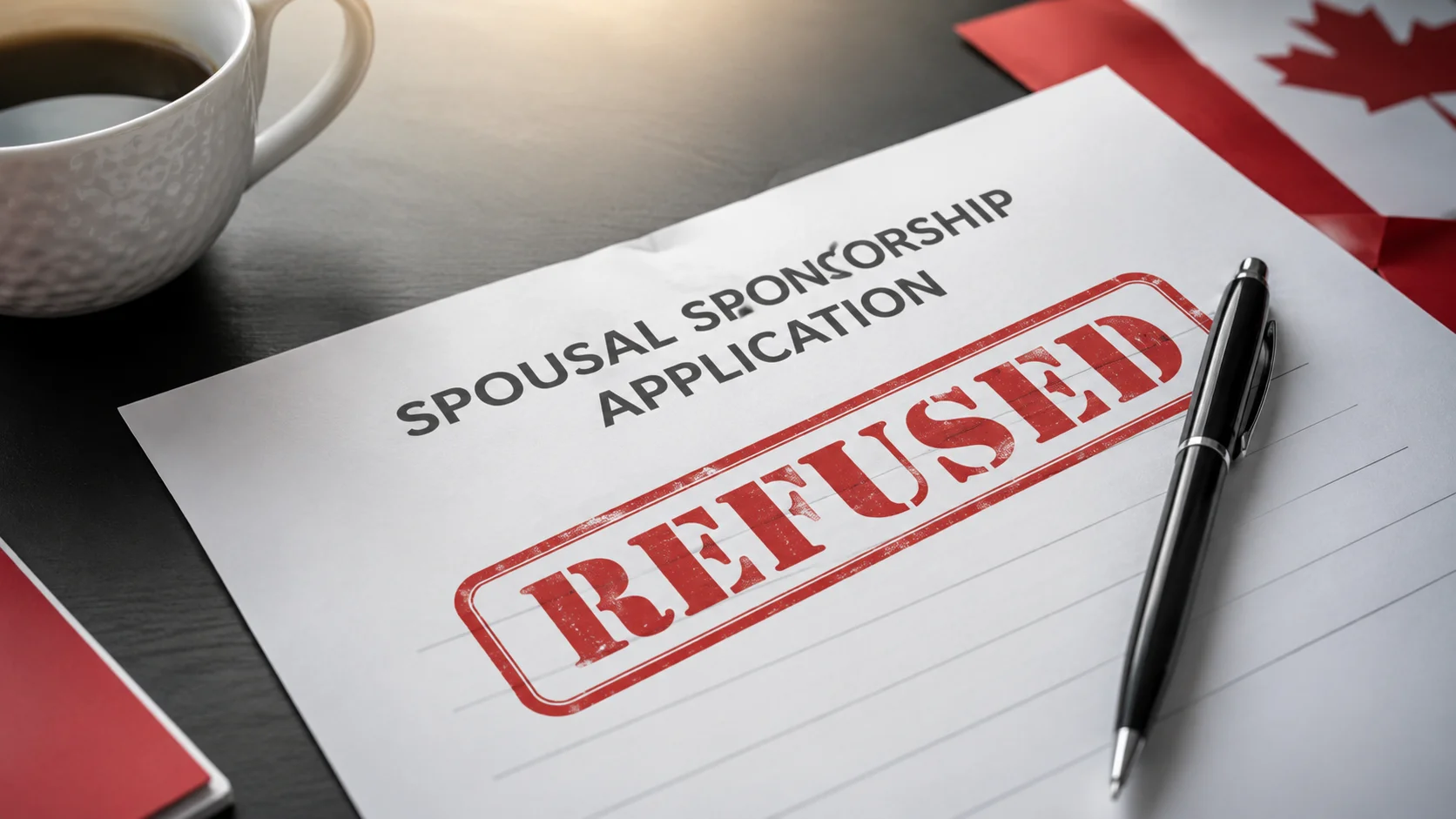
A spousal sponsorship refusal is one of the most painful outcomes in Canadian immigration. Months of preparation, thousands of dollars in fees, and the emotional weight of continued separation, all ending in a letter that says no. What makes it harder is that most refusals are preventable. Not all of them, but the majority stem from problems that existed in the application before it was submitted and that a careful review could have caught.
This guide covers all 11 refusal grounds that IRCC officers apply to spousal sponsorship applications in 2026. Each one is explained legally, contextually, and practically. Where prevention is possible, the strategy is named directly.
The disjunctive test
Under Section 4(1) of IRPR, an officer needs to find only ONE of two conditions to refuse on relationship grounds: the relationship is not genuine, OR it was entered into primarily for immigration. You must satisfy both tests simultaneously. The officer only needs to fail you on one.
Wondering if your situation qualifies?
Book a ConsultationThe 11 Refusal Grounds
1. Relationship Not Genuine — Section 4(1) IRPR
The most common and most consequential refusal ground. An officer who concludes the relationship is not a genuine conjugal partnership will refuse the application regardless of a marriage certificate, regardless of children, and regardless of how long the couple has been together. Genuineness is assessed against the totality of the evidence: how the couple met, how the relationship developed, the quality and depth of communication, financial interdependence, shared knowledge of each other’s lives, in-person visits, family awareness, and consistency across all forms.
Prevention: Build evidence across all four pillars — documentary, financial, communication, and social — covering the full timeline of the relationship from its beginning to the date of submission. Thin evidence from any single pillar leaves the officer with an incomplete picture. Comprehensive, coherent evidence across all four is the only genuine prevention strategy.
2. Relationship Entered Into Primarily for Immigration — Section 4(1) IRPR
The second prong of the Section 4 test. Even if the relationship is now genuine, an officer can refuse if they determine that the primary purpose for which it was entered into was to acquire immigration status. This is distinct from Refusal Ground 1. A couple genuinely in love today can still be refused if the evidence suggests that immigration was the dominant motivation when the relationship began — for example, a marriage occurring days before a work permit expired.
Prevention: The IMM 5532 narrative must explain the relationship timeline honestly, including its origins, in a way that demonstrates the couple’s genuine motivations. Any suspicious timing must be addressed proactively in the application with context and supporting evidence, not left for the officer to interpret.
3. Misrepresentation — Section 40 IRPA
Providing false information, omitting material facts, or submitting fraudulent documents constitutes misrepresentation under Section 40 of the Immigration and Refugee Protection Act (IRPA). A misrepresentation finding results in refusal of the application, a five-year ban on all future Canadian immigration applications, and potential consequences for the sponsored person’s existing status in Canada. Misrepresentation does not require intent. Omitting a prior marriage, a prior visa refusal, or an undeclared child can be found to constitute misrepresentation even if the omission was not deliberate.
Prevention: Full, honest disclosure throughout every form. Cross-reference all forms before submitting to confirm that details align. If there is any immigration history, criminal history, prior marriage, or other material fact that could be relevant, include and explain it rather than omit it.
4. Undeclared Excluded Family Member — Regulation 117(9)(d)
This is the most permanent and irreversible refusal ground in spousal sponsorship law. If a sponsor became a permanent resident and failed to declare their spouse or partner in that prior PR application — even if they were not intending to sponsor them at that time — the person they failed to declare is permanently excluded from being sponsored. There is no appeal right to the IAD for R117(9)(d) exclusions. The Federal Court has confirmed this exclusion applies regardless of the reason the person was not declared.
Prevention: Before submitting any spousal sponsorship application, review the sponsor’s original PR application file to confirm whether the person being sponsored now was declared as a family member at that time. This is non-negotiable due diligence for anyone who became a PR while in a relationship.
5. Sponsor Ineligibility
If the sponsor does not meet IRCC’s eligibility requirements — whether due to the five-year bar, the three-year undertaking bar, active bankruptcy, receipt of social assistance, a disqualifying criminal conviction, or a prior undertaking default — the application is refused or returned at the sponsor assessment stage. Sponsor ineligibility is assessed before the relationship itself is reviewed.
Prevention: Confirm every eligibility condition before filing. See Cluster 2A for the complete eligibility checklist. Discovering an ineligibility issue before submission protects fees and processing time. Discovering it during processing means losing both.
6. Sponsored Person Criminal Inadmissibility
A criminal record in the sponsored person’s country of citizenship or in Canada can create an inadmissibility finding that refuses the permanent residence application regardless of the relationship’s genuineness. Officers assess foreign convictions against their Canadian criminal law equivalents. Serious criminality — convictions carrying a Canadian equivalent of 10 years or more — creates stronger barriers than non-serious criminality.
Prevention: Identify any criminal record before submitting. If the record is old and may qualify for deemed rehabilitation, confirm the legal eligibility before assuming. For records within the five-year rehabilitation window, file a Criminal Rehabilitation application simultaneously with the sponsorship. Concealing a criminal record is always more damaging than disclosing it.
7. Sponsored Person Medical Inadmissibility
If the immigration medical examination reveals a health condition that creates a danger to public health or public safety, the application may be refused. Note that the excessive demand on health services rule — which applies in economic immigration streams — generally does not apply to sponsored spouses under the family class. The inadmissibility grounds relevant to most spousal sponsorship files are limited to conditions involving direct public health or safety risks.
Prevention: Complete the medical examination with an IRCC-approved panel physician and disclose all existing health conditions honestly. If a condition is identified, seek professional immigration legal advice about whether it triggers inadmissibility before assuming the worst.
8. Incomplete Application
Technically, an incomplete application is returned rather than refused, but the practical consequences are identical: you lose non-refundable fees, you lose your processing queue position, and you restart from the beginning. Common causes include missing signatures on the IMM 5532 or IMM 1344, outdated forms used instead of the current versions, missing checklist forms (IMM 5287 and IMM 5533), and missing police certificates or translations.
Prevention: Download the current document checklist from canada.ca immediately before submitting, not weeks earlier. Every form must be from the current version. Every required signature section must be signed by the correct party. Both checklist forms must be uploaded as mandatory documents, not treated as preparation worksheets.
9. Inconsistency Between Forms and Evidence
Officers cross-reference every detail across all submitted materials. A date in the IMM 5532 that differs from a date in the IMM 0008, a claimed wedding attendance of 100 people supported by five photographs, or a described daily communication pattern contradicted by sparse call logs, all create credibility concerns that can result in a Procedural Fairness Letter or outright refusal.
Prevention: Before submitting, read the entire application package as an IRCC officer would. Map every factual claim in the IMM 5532 against the supporting evidence. Confirm that dates, names, attendees, and timelines match across every form and every supporting document. Inconsistency is a pattern the officer is specifically trained to look for.
10. Failure to Declare Spouse in a Prior Immigration Application
A pattern receiving heightened IRCC scrutiny in 2025 and 2026: a sponsor obtained permanent residence through Express Entry or another economic stream, listed their spouse as non-accompanying or did not declare them at all, and is now sponsoring that spouse. Officers treat this pattern with significant suspicion, viewing it as potentially using the non-accompanying designation strategically rather than as a genuine description of the family situation at the time.
Prevention: If the spouse was married or in a relationship with the sponsor at the time the sponsor’s PR was granted, and the spouse was not declared, seek professional advice before proceeding. The legal implications depend on the specific facts and may include R117(9)(d) exclusion. Address this proactively in the application rather than hoping IRCC does not cross-reference the prior file.
11. Sponsor Does Not Intend to Reside in Canada
For Canadian citizens sponsoring from abroad, an officer must be satisfied that the sponsor genuinely intends to return to Canada once their partner receives permanent residence. If the evidence of intent to return is thin — no Canadian tax filings, no Canadian financial ties, no housing plan, a vague or generic letter of intention — the officer may find the residence requirement unsatisfied and refuse the application.
Prevention: Build a multi-layered intent-to-return package including Canadian tax filings, proof of Canadian financial ties, a detailed cover letter explaining the return plan with a specific timeline, and evidence of concrete preparations such as housing research or employment plans. See Cluster 2D for the full intent-to-return strategy.
After a Refusal: Your Immediate Next Steps
A refusal letter arriving in the IRCC secure account starts a clock in two directions simultaneously. For outland (Family Class) refusals, you have 30 days from the refusal to file a Notice of Appeal with the Immigration Appeal Division (IAD). For inland refusals, the only recourse is Federal Court judicial review. In both cases, the immediate next step is the same: order GCMS notes through an ATIP request to obtain the officer’s detailed reasoning, and seek professional legal advice before making any decisions about how to proceed.
The refusal letter itself may not contain the full explanation for the refusal. The GCMS notes will. Understanding exactly why the officer refused is the starting point for every response strategy — whether that is an IAD appeal, a reapplication, or a Federal Court challenge.
At Can X Global Solutions, the most consistent pattern in refusal files we review is this: the relationship was genuine, but the application did not prove it. An officer who reads a file and cannot construct a clear, coherent story of a genuine partnership from the documentation in front of them has the legal authority to refuse under Section 4(1) — and they use it. After more than 10 years working across 30-plus countries, our team knows the difference between evidence that satisfies an officer and evidence that creates doubt. The time to address that difference is before submission, not after a refusal.
Need a personalized review of your file?
Get a Case ReviewFrequently Asked Questions
What is the most common reason spousal sponsorship applications are refused?
The most common refusal ground is Section 4(1) of IRPR: the relationship is not found to be genuine, or the officer determines it was entered into primarily for immigration purposes. This ground accounts for the majority of substantive refusals. Most of these refusals are based on insufficient, inconsistent, or poorly organized relationship evidence rather than on the conclusion that the relationship is definitively fake.
If I was refused, does that mean IRCC thinks my marriage is fake?
Not necessarily. A Section 4 refusal means the officer was not satisfied by the evidence before them. It does not require a finding that the marriage is fraudulent. Many genuine couples receive Section 4 refusals because their evidence package did not tell the story of their relationship compellingly enough. This is why the IAD appeal — which allows new evidence and live testimony — reverses many refusals that were technically correct based on what was in the original file.
Can I reapply after a refusal?
Yes. Reapplication after a refusal is always an option, except in the case of R117(9)(d) excluded family members, which creates a permanent bar. For other refusal grounds, reapplying with a stronger, more complete application that directly addresses the reasons for the original refusal is a viable path. Order GCMS notes before reapplying so you understand exactly what the officer’s concerns were.
Is a misrepresentation finding permanent?
A misrepresentation finding under Section 40 of IRPA results in a five-year inadmissibility ban. It is not permanent, but it is severe. During the five-year period, virtually all Canadian immigration applications will be refused. After the period ends, inadmissibility is lifted and applications can be submitted again. However, the prior misrepresentation history will remain visible in IRCC’s system and may affect how future applications are assessed.
Get Expert Immigration Advice
10+ years helping clients achieve Canadian permanent residency.
Book a ConsultationTrusted by Clients from 30+ Countries
We provide trusted and effective Immigration solutions, assisting clients from around the world in successfully starting their new life in Canada.
Most Read
View all →
Inland vs Outland Spousal Sponsorship Canada 2026: Which Stream Is Right for You?

Spousal Open Work Permit Canada 2026: How to Work While Your PR Is Processing

Who Can Sponsor a Spouse to Canada in 2026: Full Eligibility Guide
Spousal Sponsorship Canada Documents Checklist 2026