




Can AI Detect Immigration Fraud Better Than Humans? The Future of Immigration Screening


Artificial intelligence is changing the way governments think about immigration screening, fraud detection, and program integrity. For decades, immigration fraud detection relied heavily on human officers reviewing documents, comparing information, identifying inconsistencies, and exercising judgment based on experience. That human role is still important, and it will remain important. However, immigration systems are now dealing with application volumes, document types, identity records, travel histories, biometric data, and cross-border information flows that are far too large for purely manual review.
This is where artificial intelligence and advanced analytics become important. AI is not better than humans at everything. It does not understand human intention the way an experienced officer, lawyer, consultant, or investigator might. It can misunderstand context, over-detect patterns, and create fairness concerns if it is poorly designed. However, AI is extremely strong at reviewing large datasets, identifying repeated patterns, detecting anomalies, comparing information across systems, and finding inconsistencies that humans may miss in high-volume environments.
The real question is not whether AI is better than humans in every situation. It is not. The better question is whether AI can detect certain types of immigration fraud faster, more consistently, and at a larger scale than humans alone. The answer is yes, especially where the issue involves repeated patterns, document irregularities, identity inconsistencies, unusual travel behaviour, or information that does not align across multiple applications.
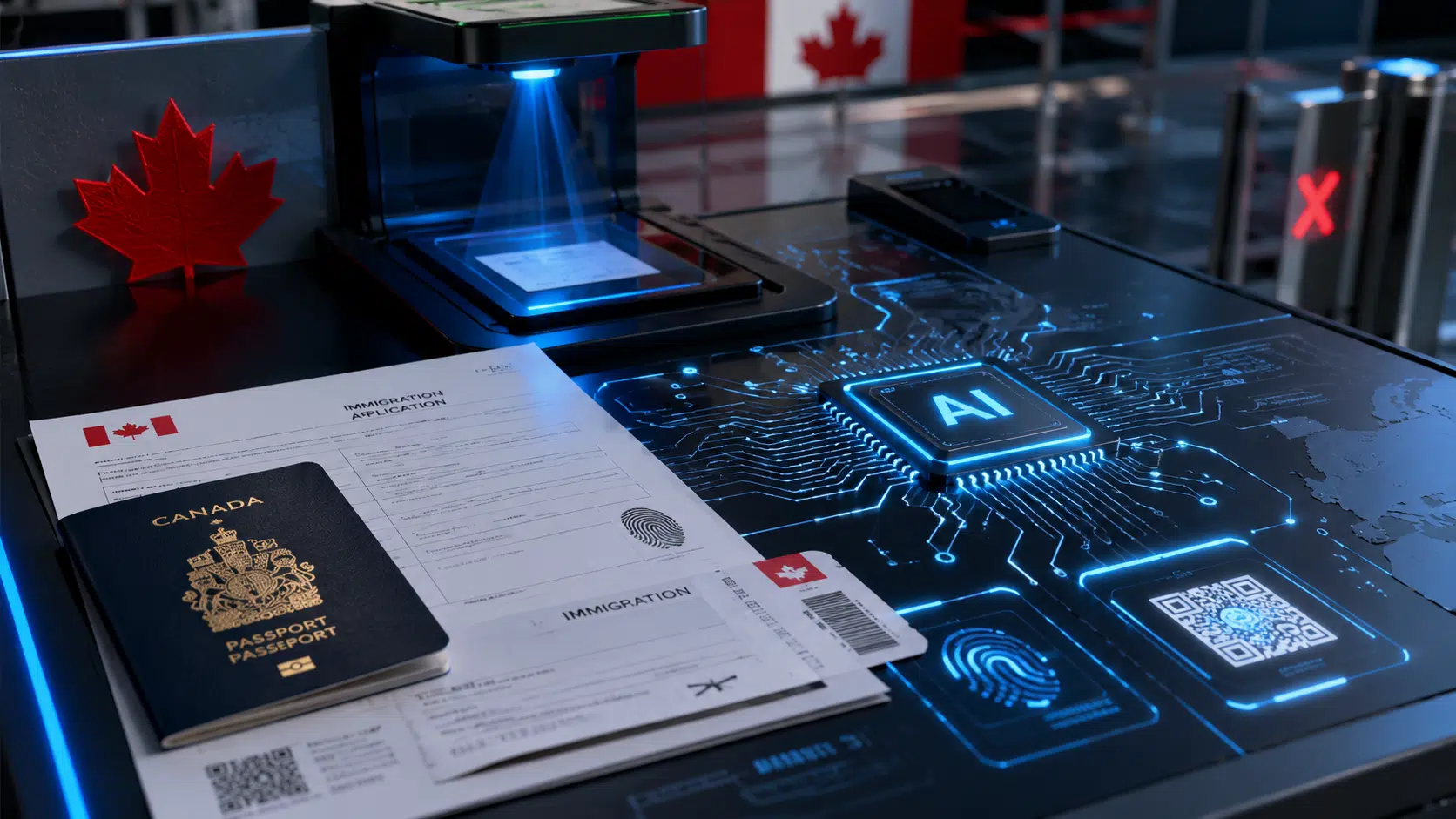
IRCC has already publicly acknowledged that it uses advanced analytics and automated systems in immigration processing, while maintaining that these tools do not refuse applications or recommend refusals. IRCC says all refusals are made by human officers based on their own review. At the same time, IRCC’s own Artificial Intelligence Strategy refers to testing an AI-powered document fraud detection tool and describes how anomaly detection systems can scan datasets to identify potentially fraudulent activity throughout the client application process. That includes irregular travel patterns, inconsistent information, unusual changes in application or biometric data, document forgery, identity theft or morphing, and visa overstays. (Canada)
This tells us where immigration screening is going. AI may not be the final decision-maker, but it is increasingly becoming part of the detection layer.
Immigration Fraud Detection Is Becoming a Data Problem
Traditional immigration fraud detection often depended on an officer noticing something unusual. A document might look altered. A job letter might appear too generic. A relationship story might not make sense. An applicant’s employment history might conflict with prior applications. A bank statement might show unusual deposits. A previous refusal might be missing from the forms.
Human officers are still capable of identifying these issues. In fact, human judgment remains essential because fraud is rarely just a technical issue. It often involves context, motive, timing, credibility, and the applicant’s broader circumstances.
However, modern immigration fraud detection increasingly involves data at a scale humans cannot manually process. One applicant may have several previous immigration applications, different addresses, prior refusals, employment records, travel history, biometrics, family information, education documents, and financial records. Multiply that by millions of applicants and the challenge becomes enormous.
AI and advanced analytics are useful because they can search across large datasets quickly. They can identify patterns that may not be obvious in one application but become visible across thousands of files. For example, a human officer may not immediately know that hundreds of applicants submitted nearly identical employment letters from the same source, used similar job duties, showed similar financial deposits, or had repeated address patterns. A data system can detect those patterns far more quickly.
This does not mean AI proves fraud by itself. It means AI can identify where human review should focus.
AI Is Strong at Pattern Detection
The main strength of AI in immigration screening is pattern detection. Fraud often leaves patterns, even when individual documents appear normal. A single employment letter may look acceptable. But if hundreds of similar letters contain identical wording, formatting, duties, dates, salary structures, or contact patterns, the system may detect a broader issue.
This is where AI can outperform human review. Human officers are limited by time, memory, and workload. AI systems can compare large volumes of data instantly. They can detect similarities across documents, identify repeated templates, flag unusual combinations of information, and highlight cases that deserve closer review.
IRCC states that it has introduced an advanced analytics-based integrity trends analysis tool that analyzes trends in application data to better detect risk and fraud patterns in applications. (Canada) This is important because it shows the direction of travel. Immigration screening is not only about reviewing one file at a time. It is increasingly about identifying trends across many files.
For honest applicants, this shift should not be frightening. It simply means applications must be accurate, consistent, and supported by real evidence. For applicants using copied documents, inflated job duties, fake employment claims, hidden refusals, or unreliable representatives, the risk is increasing.
Document Fraud Detection Will Become More Automated
Document fraud is one of the clearest areas where AI can assist immigration authorities. Immigration applications often include passports, identity documents, employment letters, bank statements, school records, police certificates, marriage certificates, tax records, pay slips, business licenses, and many other documents. Reviewing all these documents manually is difficult, especially where documents come from different countries, formats, languages, and institutions.
AI-powered document tools can potentially help identify signs of alteration, formatting inconsistencies, image manipulation, repeated templates, suspicious metadata, unusual fonts, inconsistent dates, and similarities between documents submitted by unrelated applicants. IRCC’s Artificial Intelligence Strategy specifically mentions testing an AI-powered document fraud detection tool to assess whether it can help identify fraudulent submissions in real time. (Canada)
However, document fraud detection cannot rely only on technology. Some legitimate documents look unusual because different countries, institutions, and employers use different formats. Some older records may be handwritten or poorly scanned. Some documents may contain translation issues. A tool may flag a document for review, but a human officer still needs to assess context.
The future will likely involve AI helping identify suspicious documents and humans deciding what those flags actually mean.
Identity Fraud and Biometrics Are Becoming More Important
Identity fraud is another area where AI can be powerful. Immigration authorities increasingly rely on biometrics, facial recognition-related processes, identity records, travel history, and cross-system comparisons. AI can help identify possible identity inconsistencies, duplicate identities, altered identity records, or unusual biometric patterns.
IRCC’s AI Strategy refers to anomaly detection systems identifying unusual changes in application or biometric data, identity theft or morphing, and other potentially fraudulent activities. (Canada) This type of screening is very difficult for humans to conduct manually across millions of records.
However, identity technologies also raise serious fairness and privacy questions. Biometric and identity systems must be accurate, carefully governed, and subject to meaningful human oversight. Errors in identity matching can have serious consequences. A false match or mistaken identity concern can delay or damage an application.
That is why technology may be useful, but it cannot replace procedural fairness. If an applicant is accused of identity-related concerns, they should have a meaningful opportunity to understand and respond to the issue.
Have questions about your work permit options?
Book a ConsultationAI Can Detect Inconsistencies Across Immigration History
One of the most important future uses of AI in immigration screening is cross-application consistency review. Many applicants have long immigration histories. They may have applied for a visitor visa years ago, later applied for a study permit, then a work permit, then permanent residence. Each application contains dates, addresses, employment history, marital information, family details, travel records, and refusal disclosures.
Humans can compare these records, but AI can make inconsistencies easier to detect. If an applicant listed one employment period in a previous application and a different period in a later application, the system may eventually be able to flag the inconsistency. If a previous refusal was disclosed in one file but omitted in another, that discrepancy may become visible. If family composition changes without explanation, the system may identify the gap.
This does not mean every inconsistency is fraud. People make mistakes. Representatives make errors. Dates may be approximate. Some forms require different levels of detail. But unexplained inconsistencies can create credibility concerns.
The lesson is simple. Applicants should treat immigration history as one continuous record. They should never prepare a new application without reviewing what was previously submitted.
AI May Help Detect Ghost Consultants and Organized Schemes
Immigration fraud is not always committed by individual applicants acting alone. Sometimes it involves ghost consultants, document vendors, fake employers, staged employment offers, fraudulent schools, or organized networks that prepare similar applications for many people.
AI can be useful because organized fraud often produces repeated patterns. Similar letters, repeated addresses, identical formatting, recurring employers, repeated phone numbers, unusual document structures, or clusters of similar financial transactions may become detectable across large datasets.
Human officers may identify one suspicious case. AI may help connect many suspicious cases.
This is why the future of immigration screening may increasingly focus on networks rather than isolated files. If a system detects that many applications share unusual similarities, it may trigger deeper investigation. That could affect not only fraudulent cases but also innocent applicants who unknowingly used the wrong representative or unreliable documents.
Applicants should be extremely careful about who prepares their applications and what documents are submitted in their name. Immigration authorities may hold applicants responsible for the contents of their applications, even where third parties prepared the documents.
Human Officers Are Still Better at Context
AI is powerful, but it has limitations. Fraud detection is not only about spotting patterns. It is also about understanding context.
A sudden deposit in a bank account may look suspicious to a system, but it may be perfectly legitimate if it came from a property sale, inheritance, business transaction, or education loan. A relationship timeline may look unusual, but cultural, family, religious, or personal circumstances may explain it. A job title may appear inconsistent with duties, but industry-specific practices may clarify the issue. A document may look different from standard templates because the issuing authority uses a different format.
This is where human officers remain essential. Humans can interpret context, assess explanations, understand cultural differences, consider legal standards, and evaluate evidence in a broader way.
The best fraud detection model is not AI replacing humans. It is AI supporting humans while humans remain responsible for fairness, context, and final judgment.
Need help preparing a strong application?
Get a Personalized AssessmentThe Risk of False Positives
One of the biggest risks in AI-based fraud detection is false positives. A false positive occurs when a system flags something as suspicious even though it is legitimate.
In immigration, false positives can be very serious. A flagged document, identity concern, or inconsistency may delay processing, trigger procedural fairness concerns, or lead to refusal if not handled properly. Applicants may be forced to explain issues they did not cause or defend documents that are genuine.
This is why transparency and procedural fairness matter. Applicants should not be refused based on secret or unexplained technology-driven suspicion without a meaningful opportunity to respond. AI can identify risk, but risk is not proof. A flag should lead to careful review, not automatic conclusions.
The Government of Canada’s Directive on Automated Decision-Making emphasizes risk management, transparency, quality assurance, and appropriate human intervention in automated systems. (Canada) These safeguards become especially important in immigration because decisions can affect families, careers, education, and long-term futures.
AI Can Help Officers, But It Can Also Create Bias Risks
AI systems learn from data or operate based on rules created by humans. If the data reflects historical bias, incomplete information, or uneven enforcement patterns, the system can reproduce those problems. If rules are designed too broadly, they may flag applicants unfairly. If certain countries, document types, languages, or travel patterns are over-associated with risk, innocent applicants may face increased scrutiny.
This is not a reason to reject AI completely. It is a reason to govern AI carefully.
Immigration screening must remain fair, explainable, and accountable. Applicants should not be disadvantaged by opaque systems they cannot understand or challenge. Government departments using AI must ensure systems are tested, monitored, audited, and reviewed for fairness.
Efficiency is not enough. Accuracy is not enough. Fairness matters too.
AI Will Make Generic and Copied Documents Riskier
One practical consequence of AI-assisted screening is that copied or generic documents may become much riskier. If many applicants submit similar job duties, similar SOP language, similar support letters, or similar relationship narratives, systems may eventually detect these similarities more easily.
This does not mean applicants cannot use professional help or AI tools for drafting. It means final documents must reflect real facts.
A copied employment letter may look polished, but if it does not reflect actual duties, it creates risk. An AI-written SOP may sound impressive, but if it lacks personal detail, it may weaken credibility. A generic support letter may appear professional, but if it does not explain real circumstances, it may not help.
In the future, authenticity may become more important than polish.
Want to speak with a licensed RCIC?
Speak With an ExpertWhat Applicants Should Do Differently
Applicants should assume that immigration screening is becoming more data-driven and pattern-aware. That does not mean applicants should be afraid. It means they should prepare more carefully.
Every application should be accurate, consistent, and supported by evidence. Previous refusals should be disclosed. Employment history should match prior applications. Financial deposits should be explained. Relationship evidence should be genuine and organized. Job duties should reflect actual work. Education history should be complete. Any unusual fact should be explained before it becomes a concern.
Applicants should also review the work of representatives carefully. If a consultant, agent, friend, employer, or recruiter prepares documents, applicants should still review everything before submission. In immigration, signing an application often means accepting responsibility for the information provided.
AI may help detect fraud better than humans in some areas, but it also means careless applications may become more vulnerable.
The Future of Immigration Screening
The future of immigration screening will likely involve a hybrid model. AI and advanced analytics will assist with pattern detection, document review, identity screening, anomaly detection, and workload triage. Human officers will continue to interpret context, assess credibility, apply legal standards, and make final decisions.
This hybrid model can be beneficial if used responsibly. It can help detect fraud, protect program integrity, reduce backlogs, and allow officers to focus on complex cases. But it must be governed carefully to avoid unfairness, over-reliance, opacity, and false positives.
The future should not be AI replacing human judgment. The future should be better tools supporting better human decisions.
Final Thoughts
Can AI detect immigration fraud better than humans? In some ways, yes. AI is better at scale, speed, pattern recognition, document comparison, anomaly detection, and cross-system consistency review. Humans are better at context, fairness, judgment, cultural understanding, legal reasoning, and proportionality.
The strongest immigration screening system will not be purely AI or purely human. It will be a carefully governed combination of both.
For applicants, the message is clear. Immigration applications must now be prepared for a world where systems can compare, detect, and analyze patterns more efficiently than ever before. Weak documents, copied letters, hidden refusals, unexplained financial movements, and inconsistent histories are becoming harder to hide.
In the future of immigration screening, credibility will not only be reviewed by officers.
It will increasingly be tested by systems.
How Can X Global Can Help
At Can X Global, we understand that immigration screening is changing. Applications are no longer reviewed only as individual document packages. They are increasingly assessed within a broader environment involving data, patterns, prior history, credibility indicators, and program integrity concerns.
Our team reviews applications with this modern reality in mind. We assess immigration history, refusal risks, document consistency, employment evidence, financial records, relationship evidence, study plans, and potential credibility concerns before submission.
Because in an AI-assisted immigration system, success is not about submitting more documents.
It is about submitting a truthful, consistent, and credible application that can withstand both human judgment and modern screening systems.
Want your application reviewed by a licensed RCIC?
Book a ConsultationRelated Articles
- How Artificial Intelligence Is Quietly Changing Canadian Immigration Decisions in 2026
- Does IRCC Use AI to Refuse Applications? Inside Chinook, Automation, and Modern Immigration Processing
- AI vs Human Officers: Who Really Decides Your Canadian Immigration Application?
- The Hidden Risks of Using ChatGPT for Immigration Applications: Mistakes That Are Leading to Refusals
Get Expert Immigration Advice
10+ years helping clients achieve Canadian permanent residency.
Book a ConsultationTrusted by Clients from 30+ Countries
We provide trusted and effective Immigration solutions, assisting clients from around the world in successfully starting their new life in Canada.