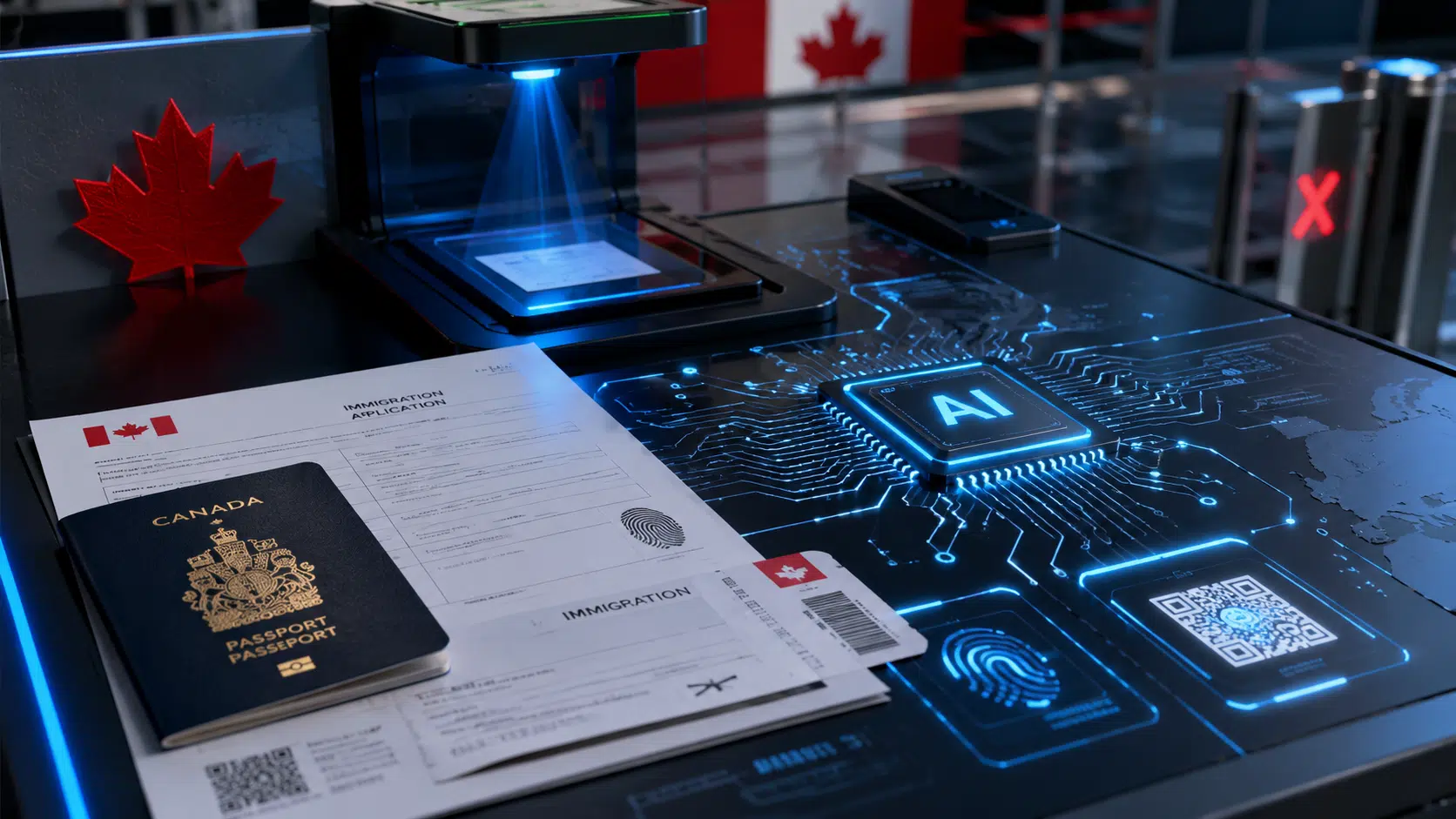
Inside the Future of Immigration: How AI May Predict Refusals Before Applicants Even Apply


Artificial intelligence is beginning to change immigration in a way many applicants still do not fully understand. The public conversation usually focuses on whether AI is refusing applications or replacing immigration officers. That question matters, but it is not the full picture. The more important future question may be different: can AI predict whether an immigration application is likely to be refused before the applicant even submits it?
The answer is increasingly yes, at least in certain ways.
This does not mean AI can guarantee an approval or predict every officer’s decision with certainty. Immigration decisions involve law, evidence, discretion, credibility, human judgment, changing policy, and facts unique to each applicant. No responsible AI system should tell someone that approval is guaranteed. However, AI can identify risk patterns before submission. It can analyze whether an application has common refusal indicators, missing evidence, inconsistent dates, weak financial explanations, poor program logic, incorrect job duties, undisclosed immigration history, or documents that do not support the claims being made.
That is where the future of immigration may be heading.
AI may not simply help governments process applications. It may also help applicants and professionals detect refusal risks before the file ever reaches IRCC. Used responsibly, this could be one of the most valuable uses of immigration technology. Used carelessly, it could create false confidence, bad advice, and more refusals.
Immigration Is Moving From Reactive Refusals to Predictive Risk Analysis
For decades, applicants usually discovered weaknesses only after refusal. A person submitted a study permit application and later learned the officer was not satisfied with the purpose of study. A visitor visa applicant found out after refusal that home-country ties were considered weak. A work permit applicant discovered too late that their employment evidence did not prove they qualified for the role. An Express Entry applicant learned after refusal that the officer did not accept the claimed work experience.
This reactive model is painful because by the time the weakness becomes clear, the damage is already done. Government fees may be lost, timelines may be affected, status may be at risk, program deadlines may pass, and prior refusal history may complicate future applications.
AI could change that by helping applicants detect weaknesses earlier. A properly designed AI system could review an application before submission and ask practical risk questions. Does the study plan match the applicant’s prior education? Are the employment dates consistent across documents? Do the job duties match the claimed NOC? Are there unexplained deposits in the bank statements? Was a prior refusal disclosed? Does the visitor visa purpose match the proposed duration? Does the relationship evidence support the sponsorship narrative?
This is the real power of AI in immigration. Not replacing officers. Not guaranteeing approvals. But identifying problems before they become refusal reasons.
IRCC Is Already Thinking in Terms of Data, Patterns, and Risk
It is important to understand that governments are also moving toward data-driven processing. IRCC has publicly stated that it uses advanced analytics, automation, and other technologies to help process applications faster and reduce wait times. IRCC also states that automated systems may help identify routine applications for streamlined processing, while officers remain responsible for final decisions and automated systems do not refuse applications. (Canada)
IRCC’s Artificial Intelligence Strategy also discusses future and experimental uses of AI, including anomaly detection systems that can scan datasets and identify potentially fraudulent activity throughout the client application process. IRCC describes examples such as irregular travel patterns, inconsistent information, unusual changes in application or biometric data, document forgery, identity issues, and overstays. Once flagged, human agents can investigate further. (Canada)
This tells us something important. Immigration is no longer only about reading documents one by one. It is becoming more data-aware. Systems can compare, classify, flag, sort, and identify patterns. That same logic can be used by applicants and professionals before submission. If government systems are becoming more pattern-aware, applicants must also become more pattern-aware.
What AI Can Predict Before Submission
AI cannot predict the mind of an officer with certainty. It cannot know every internal factor, every policy priority, every discretionary assessment, or every detail of processing. However, it can predict risk areas based on known refusal patterns and evidentiary weaknesses.
For study permits, AI can review whether the proposed program logically connects with the applicant’s education and employment history. It can flag possible concerns where a person with advanced education applies for a lower-level program without explanation, where there are long study gaps, where the financial plan is weak, or where the Statement of Purpose is generic. It can help identify whether the SOP answers the questions officers commonly care about: why this program, why this institution, why Canada, why now, and what happens after studies.
For visitor visas, AI can assess whether the purpose of visit is clear, whether the duration seems reasonable, whether financial records support the trip, whether employment ties are documented, and whether family ties in Canada may need stronger explanation. It can also flag cases where an invitation letter exists but the applicant’s own return obligations remain weakly proven.
For work permits, AI can compare the applicant’s experience with the offered position, identify possible licensing concerns, analyze whether job duties appear copied or generic, and flag gaps between the worker’s qualifications and the role. In LMIA-based cases, AI can help review whether the worker’s background actually supports the position approved in the LMIA.
For Express Entry and permanent residence, AI can help detect inconsistencies in work history, NOC duties, CRS point claims, proof of funds, personal history, family composition, and document completeness. It can warn applicants where reference letters do not sufficiently prove main duties or where the claimed points may not be fully supported.
This type of predictive review can be extremely valuable because many refusals are preventable. The issue is often not that the applicant had no chance. The issue is that the risk was not identified before submission.
AI Could Become a Pre-Submission Refusal Simulator
The future of immigration technology may include pre-submission refusal simulation. This does not mean a system should claim to know the exact outcome. Instead, it could analyze an application and produce a risk profile showing where refusal concerns may arise.
For example, a study permit risk report might say that the program rationale is weak because the applicant already completed a similar credential, the financial evidence contains large unexplained deposits, and the future career plan is not supported by labour market or employment evidence. A visitor visa risk report might identify weak home-country ties, unclear purpose, and insufficient evidence of return obligations. A work permit risk report might flag that the applicant’s duties do not align with the claimed occupation or that licensing requirements have not been addressed.
This could change immigration preparation significantly. Instead of waiting for IRCC to refuse the application, applicants could correct weaknesses before submission. They could obtain better employment letters, explain financial deposits, revise study plans, disclose prior refusals properly, strengthen relationship evidence, or reconsider whether the strategy itself makes sense.
A refusal simulator would not replace professional judgment, but it could become a powerful quality control tool.
Have questions about your work permit options?
Book a ConsultationThe Best AI Will Not Just Write Documents. It Will Challenge Weak Files.
Many applicants currently use AI mainly to write. They ask AI to draft SOPs, employment letters, invitation letters, support letters, and reconsideration requests. That is useful only to a limited extent. The future of immigration AI should not be document production alone. It should be risk detection.
A writing-focused AI may make a weak case sound better. A strategy-focused AI should tell the applicant that the case is still weak. That is the difference between dangerous AI and useful AI.
For example, if an applicant asks AI to write an SOP for a weak study permit file, a basic AI tool may produce a polished letter. A better immigration AI tool should first ask whether the program choice makes sense, whether finances are properly documented, whether prior refusals exist, whether the applicant’s future plan is realistic, and whether home-country ties are supported. It should identify the problem before writing the letter.
This is where AI could truly help applicants. Not by making every application sound perfect, but by helping applicants understand what is not yet ready.
AI Could Reduce Preventable Refusals
A large number of refusals happen because applicants do not understand what officers are assessing. Many people believe that if they upload the required documents, the application is complete. However, completeness and persuasiveness are not the same.
A visitor visa application may be complete but weak. A study permit application may include all mandatory documents but still fail because the study plan does not make sense. A work permit application may include a job offer but fail because the applicant does not prove qualifications. A PR application may include employment letters but fail because duties do not establish the claimed NOC.
AI can help close this gap by reviewing applications not only for missing documents but for weak logic. It can identify whether the evidence actually proves what the applicant claims. This is much more valuable than a checklist.
A checklist asks whether a document exists.
A risk engine asks whether the document works.
That is the future.
But AI Prediction Can Also Create False Confidence
There is a serious danger in predictive immigration AI. If a platform gives applicants a score or says they are “low risk,” applicants may assume approval is likely. That can be dangerous because immigration decisions are not mathematical guarantees.
An AI tool may miss a legal issue. It may rely on outdated rules. It may not understand country-specific documents. It may fail to appreciate officer discretion. It may not know how a visa office is currently assessing similar files. It may not properly evaluate credibility. It may not understand cultural context, family circumstances, or unusual facts.
This is why AI tools must be careful with language. They should not say, “You will be approved.” They should say, “Based on the information provided, these are the risk areas we identified.” Responsible AI should explain uncertainty rather than hide it.
A predictive tool can reduce risk.
It cannot eliminate risk.
Need help preparing a strong application?
Get a Personalized AssessmentPredictive AI Must Be Grounded in Current Law and Policy
Immigration rules change constantly. A predictive AI platform is only useful if it is grounded in current law, policy, program instructions, official guidance, and real refusal trends. If the system relies on outdated information, it may create more harm than good.
For example, a work permit rule may change. A study permit policy may tighten. A proof of funds requirement may increase. An Express Entry category may shift. A provincial program may pause or change criteria. A platform that fails to update quickly could lead applicants toward strategies that no longer work.
This is why the future of AI immigration platforms must involve source grounding, regular updates, professional oversight, and clear limits. A tool that confidently gives old advice is more dangerous than a tool that admits it does not know.
Human Judgment Will Remain Essential
AI can identify patterns, but immigration still requires judgment. A system may flag a sudden deposit as risky, but a professional may recognize that it came from a legitimate property sale and can be documented. AI may flag a program change as illogical, but a human advisor may understand the applicant’s career transition. AI may flag a short relationship timeline, but cultural or family context may explain it.
This is why the future is not AI alone. The future is AI-assisted professional review. AI can help identify risks faster. Human professionals can decide what the risks mean and how to address them.
The best immigration systems will combine machine efficiency with human judgment. AI can review patterns. Humans can understand context. Both are needed.
Ethical Risks of Predicting Refusals
Predictive immigration technology also raises ethical concerns. If an AI tool predicts refusal risk, who controls the model? What data was used? Does the model reflect past bias? Does it unfairly disadvantage applicants from certain countries, occupations, age groups, or backgrounds? Does it treat correlation as causation? Does it explain its reasoning clearly?
These questions matter because immigration decisions are life-changing. A flawed predictive tool could discourage eligible applicants from applying or push them toward unnecessary services. It could also overstate risk and create fear.
Responsible predictive AI should not be a fear machine. It should be an educational and quality-control tool. It should explain why a risk exists and how it may be addressed. It should avoid discriminatory assumptions and should be reviewed by professionals who understand immigration law and ethics.
Canada’s Directive on Automated Decision-Making emphasizes transparency, accountability, quality assurance, and recourse in automated decision systems. (TBS-SCT Canada) These principles matter not only for government systems but also for private immigration technology platforms.
Want to speak with a licensed RCIC?
Speak With an ExpertThe Future Applicant Will Prepare Differently
Over the next few years, applicants may begin using AI before they even decide which immigration pathway to pursue. Instead of asking only whether they qualify, applicants may ask whether their evidence is strong enough, whether their documents are consistent, whether their strategy creates refusal risk, and whether they should apply now or wait until the file is stronger.
This is a major shift. The applicant of the past often applied first and learned from refusal later. The applicant of the future may run a risk analysis before applying.
That could save time, money, and stress.
It could also reduce repeated refusals and improve application quality.
However, applicants must understand that AI risk analysis is only as good as the facts entered. If applicants hide refusals, omit prior applications, exaggerate employment, or provide incomplete information, the AI review will be unreliable. Honest input remains essential.
How Applicants Can Use Predictive AI Safely
Applicants should use predictive AI as a preparation tool, not as a final authority. A good AI review can help identify weak areas, but applicants should still verify legal requirements, review official sources, and seek professional advice for complex cases.
Applicants should also avoid using AI only to make documents sound better. The more useful approach is to ask AI to find weaknesses. Where is the application unclear? What would an officer question? Which evidence is missing? What facts appear inconsistent? What assumptions need proof?
The safest use of AI is not polishing.
It is stress-testing.
A strong application should survive difficult questions before submission.
Final Thoughts
AI may eventually predict immigration refusals before applicants apply, but not in the way many people imagine. It will not be a crystal ball. It will not guarantee approval. It will not replace the officer. It will not remove uncertainty from immigration law.
Its real value will be in identifying risk.
AI can help detect weak study plans, unclear visitor purposes, unsupported job duties, inconsistent work histories, unexplained funds, missing disclosures, and poor evidence alignment. It can help applicants understand what may go wrong before they lose time, money, and opportunities.
But AI must be used responsibly. Predictive immigration tools must be transparent, current, evidence-based, and supervised by human judgment. Otherwise, they may create false confidence or unnecessary fear.
The future of immigration will not belong to applicants who simply ask AI to write better letters.
It will belong to applicants who use AI to build stronger, clearer, more credible applications before they apply.
How Can X Global Can Help
At Can X Global, we believe the future of immigration preparation will involve intelligent risk detection, not blind document generation. Our team reviews applications through both a legal and systems-based lens, assessing eligibility, prior refusals, officer concerns, financial evidence, employment history, study plans, relationship evidence, and credibility risks before submission.
AI can help identify patterns, but professional judgment determines strategy.
Because the strongest application is not the one that looks perfect after submission.
It is the one that was stress-tested before submission.
Want your application reviewed by a licensed RCIC?
Book a ConsultationRelated Articles
- How Artificial Intelligence Is Quietly Changing Canadian Immigration Decisions in 2026
- Does IRCC Use AI to Refuse Applications? Inside Chinook, Automation, and Modern Immigration Processing
- AI vs Human Officers: Who Really Decides Your Canadian Immigration Application?
- Can AI Detect Immigration Fraud Better Than Humans? The Future of Immigration Screening
Get Expert Immigration Advice
10+ years helping clients achieve Canadian permanent residency.
Book a ConsultationTrusted by Clients from 30+ Countries
We provide trusted and effective Immigration solutions, assisting clients from around the world in successfully starting their new life in Canada.